Central anchor1/13
Pythagorean Theorem
Why did one right-triangle equation crack the world of fractions?
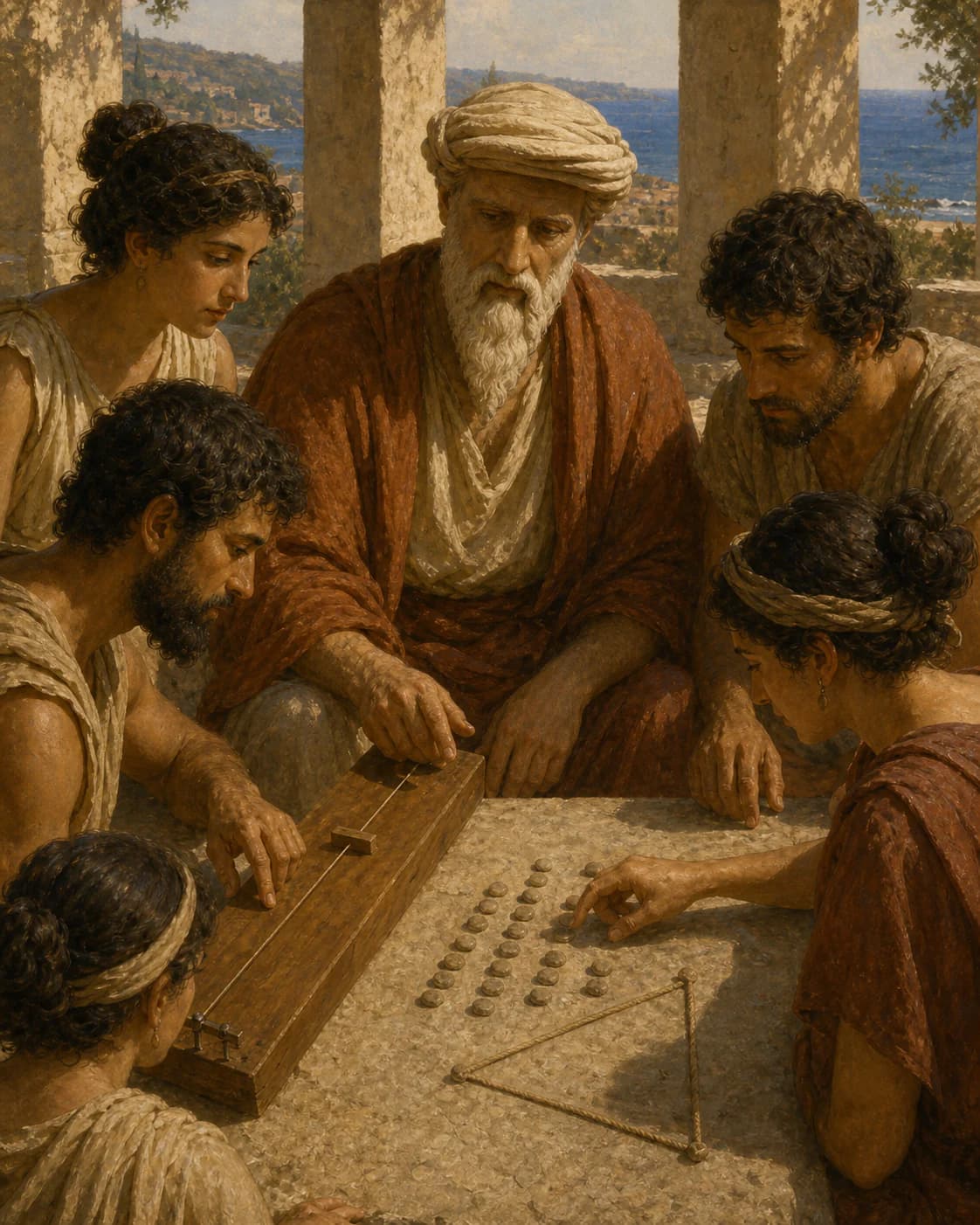
Not one man’s theorem, but a community testing number and ratio
No verified lifetime portrait or writing by Pythagoras survives. The low wrapped head covering, long beard, and lowered gaze use the later Capitoline herm type only as an identifying convention, not evidence of appearance. The Croton scene interprets later traditions as communal inquiry and does not establish the theorem or incommensurability as one man's sole achievement.
MathVoyage editorial direction · OpenAI image generation · later Capitoline herm iconography reference · no verified lifetime likeness · 2026-08-07
Remember the mind, not only the dates
The idea to carry forward
The Pythagorean tradition tried to read the world’s order through number and ratio.Enter through one scene
Later traditions say that after leaving Samos he settled at Crotone in southern Italy and founded a community combining religious rules of life with mathematics, music, and astronomy. Details of his travels and membership numbers are uncertain.
Questions this person helps open
These are reverse projections of existing editorial routes, not claims of direct influence or sole invention.
Why did one right-triangle equation crack the world of fractions?
PROFILE 02 · DEEP VOYAGE
Instead of memorizing more dates, follow the world that shaped this mind, the scenes that changed its direction, and the questions carried onward.
CHAPTER 01 · PERSON AND PERIOD
Before the finished achievement, read what this person treated as a problem and where the surviving evidence reaches its limit.
Remembered through the phrase all is number, Pythagoras founded a community at Crotone that combined mathematics, music, astronomy, ethics, and rules of life. No writing by him survives, and later Pythagorean sources often attribute a community’s work to its founder, so individual discoveries are difficult to assign. Musical ratios, the organization of results about right triangles, and debates over incommensurable magnitudes all belong to this wider tradition. Stories about forbidden beans or Hippasus drowning appear in later, conflicting forms and should be read as traditions rather than eyewitness history.
CHAPTER 02 · TURNING SCENES
Follow the moments when the idea moved one step further. Every scene continues through an evidenced place or an honestly labelled time context.
Scene 1 / 3
Later traditions say that after leaving Samos he settled at Crotone in southern Italy and founded a community combining religious rules of life with mathematics, music, and astronomy. Details of his travels and membership numbers are uncertain.
Scene 2 / 3
The relation was known in earlier cultures, including Babylonia. Later writers connect the Pythagorean tradition with a general proof, but no contemporary text preserves a proof by Pythagoras himself.
Scene 3 / 3
The Pythagorean tradition came to recognize that lengths such as √2 are not ratios of integers. Later sources connect Hippasus with the episode, but disagree about the discovery, disclosure, and death.
CHAPTER 04 · TOOLS LEFT BEHIND
The useful question is not a star rating, but what remained available for solving another problem.
In a right triangle, the square of the hypotenuse equals the sum of the squares of the other two sides.
THOUGHT EXPERIMENT · NOT A FACT CLAIM
This is a thought experiment about influence, not a verified historical fact.
Beginners can hear how a 2:1 string-length ratio changes a musical interval. Intermediate learners calculate integer ratios and right triangles; advanced learners prove why √2 is not rational. Experts then compare mathematical proof with source criticism, asking why a theorem and its historical attribution require different kinds of evidence.
STANDING ON SHOULDERS · EVIDENCED CONNECTIONS
We do not draw a line merely because two people shared an era. Only connections traced through works, problems, or teaching appear with an explanation and evidence.
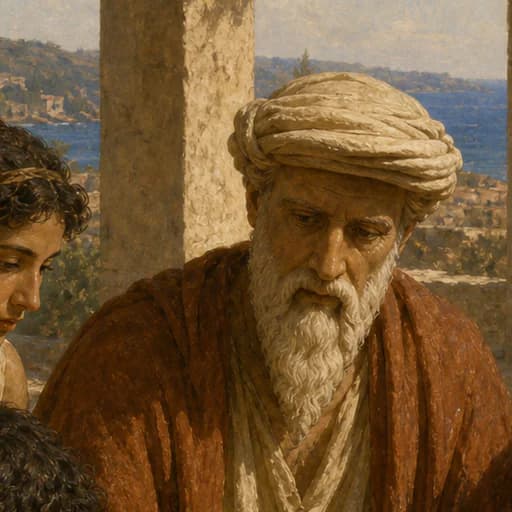
Pythagoras
Greek Period
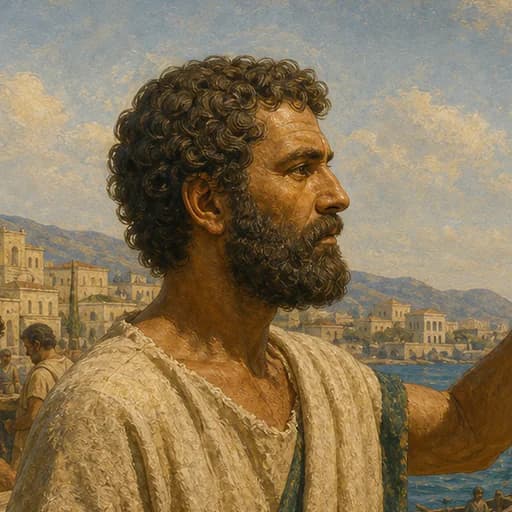
A traditional teacher, a traceable intellectual inheritance
Later biographies say Pythagoras studied with Thales, but no contemporary record survives. This edge does not assert a documented lesson; it marks the Pythagorean school’s continuation of the Ionian investigation of number and geometry.
Evidence for this connection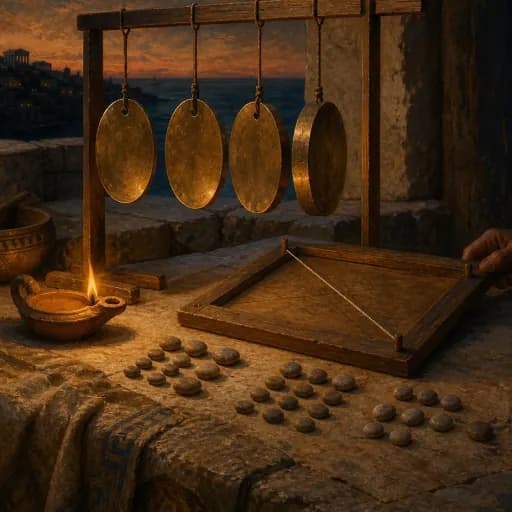
√2 overturns the school’s belief
Hippasus is associated with the Pythagorean tradition in accounts of incommensurability. Details of the discovery and his death are legendary, but the mathematical rupture is clear: irrational magnitude broke the school’s belief that every quantity was a ratio of integers.
Evidence for this connectionCurated sources and problems. Bring one discovery back from OEIS, Project Euler, MathOverflow, or arXiv.