Thales of Miletus
Life
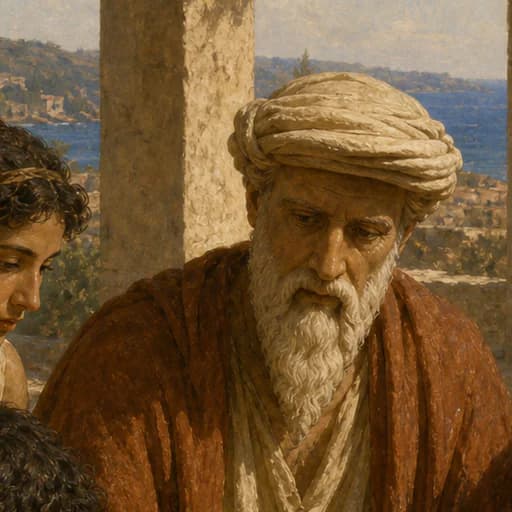
An ancient starting point that must be read carefully across later sources. No writing by Thales survives, but Aristotle reports that he sought the origin of things in water — one of the earliest Greek attempts to explain nature through a common principle rather than divine whim alone. Herodotus says Thales foretold the year of the eclipse of 585 BCE and that the Medes and Lydians stopped fighting after it. Whether anyone then could predict a solar eclipse at a particular place is disputed; modern historians also consider a rough guess or later attribution. Stories about measuring a pyramid and proving geometric theorems were recorded centuries later. Learning to separate these levels of certainty is part of what makes Thales compelling.
Decisive moments
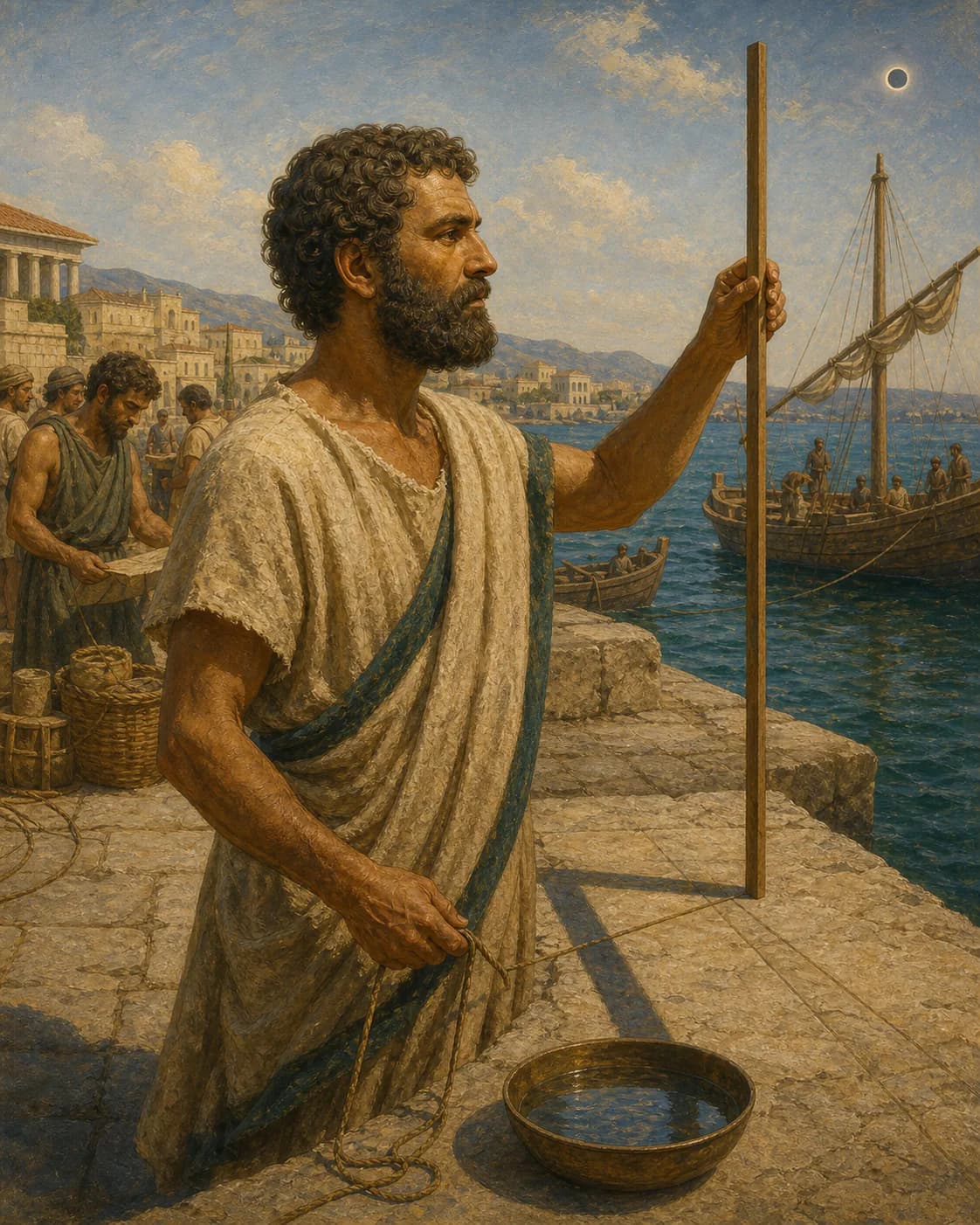
The eclipse of 585 BCE — Herodotus's account
MiletusHerodotus wrote that Thales foretold the year of an eclipse and that the Medes and Lydians stopped fighting after it. The method and precision of any prediction remain disputed.
The later attribution of Thales's theorem
Later sources attribute several results to Thales, including the right angle in a semicircle. Whether he supplied a deductive proof in the modern sense is not certain.
The tradition of measuring a pyramid
Later authors say he used equal shadow lengths or proportional triangles with a staff. It is a vivid bridge from practical measurement to general geometry, but not a contemporary record.
If this person hadn't existed
This is a thought experiment about influence, not a verified historical fact.
Greek philosophy, science, and geometry cannot all be credited to one person. What matters is that later Greek writers remembered Thales as an early marker of natural explanation and general geometric claims. Without that remembered name, the Ionian meeting of observation, measurement, and natural philosophy would be much harder to see.
Influence network
Beyond MathVoyage
Loading…