CHAPTER 01 · PERSON AND PERIOD
What questions surrounded Richard Dedekind?
Before the finished achievement, read what this person treated as a problem and where the surviving evidence reaches its limit.
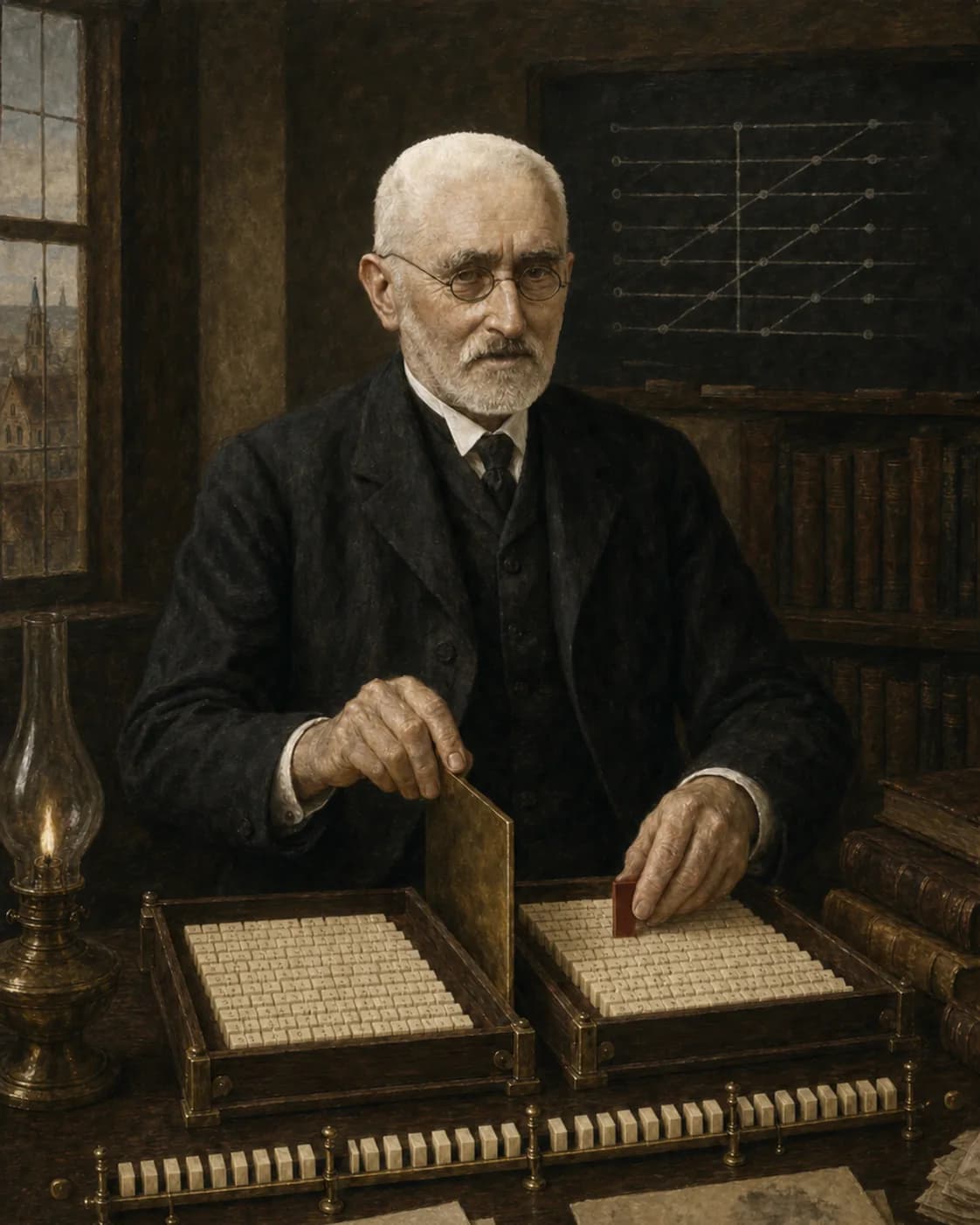
A mathematician who rebuilt the intuitive continuous line from the structure of the rational numbers. Dedekind completed a doctorate under Gauss in 1852 and is recorded as Gauss’s last doctoral pupil. While teaching in Zürich in 1858, he confronted the need for a rigorous account of real numbers. His 1872 Continuity and Irrational Numbers constructed a real number from a “cut” dividing the rationals into two classes. Méray, Cantor, and Weierstrass pursued other rigorous constructions in the same period, so this was not a solitary first. His 1888 What Are Numbers and What Should They Be? analyzed natural numbers and induction through sets and mappings. In algebraic number theory, ideals restored a form of factorization where ordinary elements no longer factored uniquely.