Sofia Kovalevskaya
Life
An analyst who built a route into research when universities kept their doors closed. The story that Ostrogradsky's calculus notes were used as wallpaper in Sofia Kovalevskaya's childhood room comes through her own recollection. Because Russian universities excluded women, she entered a marriage of convenience to study abroad, attended lectures at Heidelberg, and then studied privately with Weierstrass after Berlin refused to admit her. In 1874 Göttingen awarded a doctorate in absentia on the strength of three papers on partial differential equations, Abelian integrals, and Saturn's rings; she is widely described as the first woman to receive a doctorate in mathematics in the modern sense. Stockholm appointed her extraordinary professor in 1884 and granted her a lifetime chair in 1889. She contributed the Cauchy–Kovalevskaya theorem and major work on rigid-body rotation while also writing literature, before dying of pneumonia at 41.
Decisive moments
Calculus on the wallpaper — meeting math at 8
MoscowKovalevskaya recalled that part of a childhood room had been papered with Ostrogradsky's calculus notes and that the unfamiliar symbols fascinated her. It is best read as an origin story for her curiosity, not proof that she mastered calculus from the wall at eight.
Göttingen PhD — a first in modern mathematics
GöttingenWhile studying privately with Weierstrass, she completed three papers on PDEs, Abelian integrals, and Saturn's rings. Göttingen awarded the doctorate in absentia in 1874; it is widely regarded as the first mathematics doctorate granted to a woman in the modern sense.
Extraordinary professor at Stockholm — entering the lecture hall
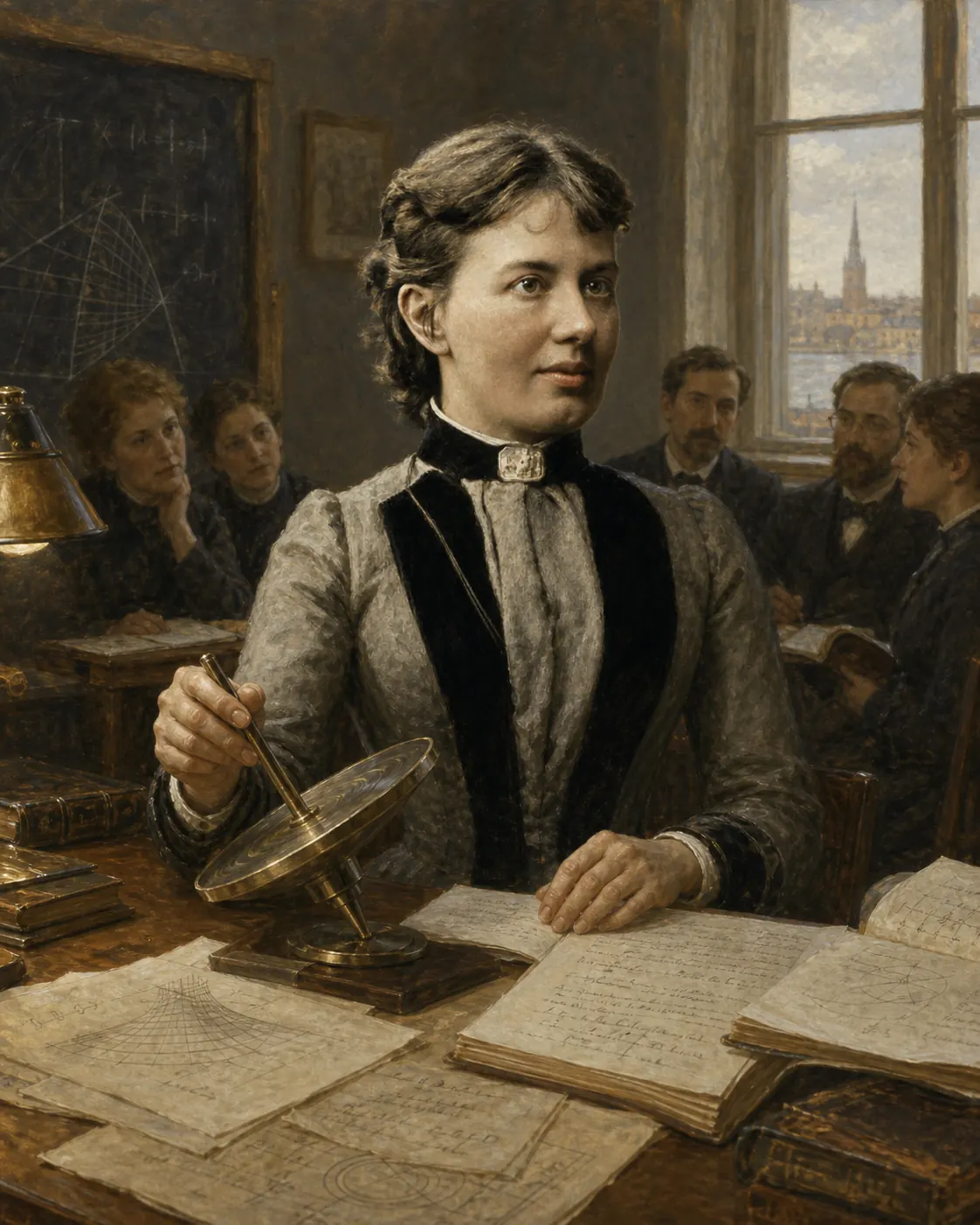
StockholmShe was appointed extraordinary professor in 1884, taught subjects including complex analysis and PDEs, and joined the work of Acta Mathematica. Her lifetime chair followed in 1889.
Bordin Prize — the motion of a top
ParisShe found a new integrable case for the rotation of a heavy rigid body about a fixed point and won the Académie des Sciences Prix Bordin. The award rose from 3,000 to 5,000 francs in recognition of the work. Although entries were formally anonymous, the judges were not unaware of her research area.
A lifetime chair at Stockholm
StockholmIn 1889 she received a lifetime chair in analysis. Because Laura Bassi and Maria Gaetana Agnesi had held earlier European chairs, this is not an all-time first; it is a major institutional milestone in modern professional mathematics.
If this person hadn't existed
This is a thought experiment about influence, not a verified historical fact.
The Cauchy–Kovalevskaya theorem gives local existence and uniqueness of analytic solutions for analytic data under a non-characteristic initial condition. We cannot measure how much her career changed the timing of later women's entry into mathematics. What it supplied was a concrete precedent: a researcher excluded by institutions nevertheless completed a doctorate, taught, edited a journal, and held a lifetime chair.
Influence network
Beyond MathVoyage
Loading…