Sophie Germain

Sophie Germain

AD 1776 - AD 1831
Paris
Enlightenment

Life

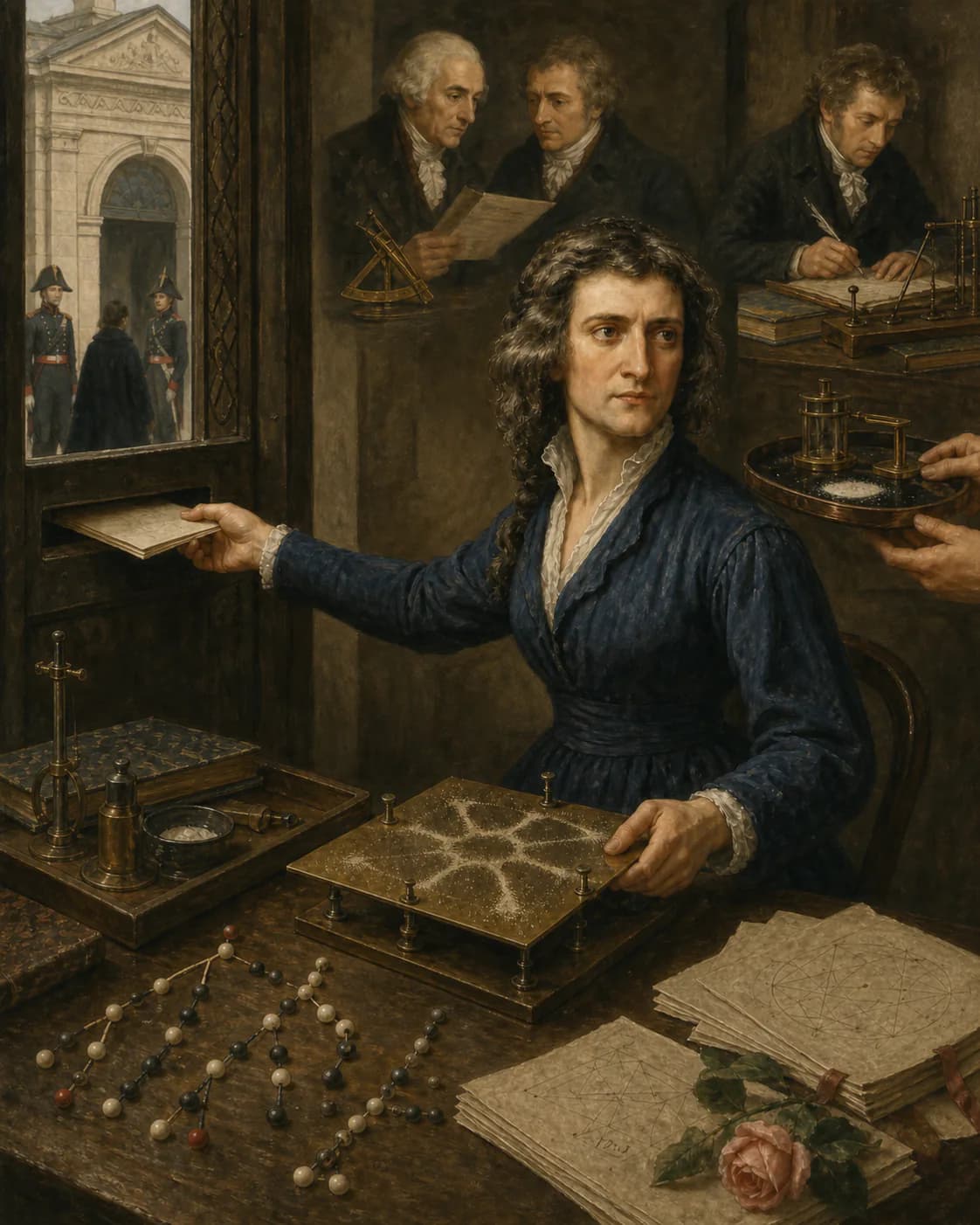
A Parisian mathematician who built independent routes into number theory and elastic plates outside the university classroom. Because women could not enroll at the École Polytechnique, Germain obtained lecture notes and submitted work under the male name Le Blanc, first to Lagrange and later to Gauss. During the Napoleonic wars she asked General Pernety to protect Gauss; this revealed her identity in 1807, and Gauss’s letter praised the talent and courage required to study through such barriers. On Fermat’s Last Theorem she used auxiliary primes to treat the “first case” for many exponents. This is an important chapter of nineteenth-century partial results, not a component directly used in Wiles’s 1995 proof. Her work on vibrating plates passed through errors and revisions before winning the French Academy prize in 1816. Alongside exclusion, the story shows how failed drafts can become better models.
In one line
Outside a closed institution, lecture notes, letters, and prize problems could form another research route.

Decisive moments

AD 1794

Studying École Polytechnique notes independently

Paris

Unable to enroll, she obtained lecture notes, studied independently, and submitted work as Le Blanc. The quality prompted Lagrange to seek out the actual author.

AD 1804

Writing to Gauss as Monsieur Le Blanc

After studying the Disquisitiones Arithmeticae, she sent Gauss her own number-theory work. The correspondence began under a pseudonym but contained concrete mathematical arguments.

AD 1807

Her identity becomes known and Gauss responds

When Pernety’s intervention revealed her identity, Gauss praised research achieved across the barriers women faced. This was not a formal supervisory relationship or a promise of lifelong patronage.

AD 1816

French Academy prize for work on elastic plates

After revising defects in earlier submissions, she won on her third attempt. Both Germain’s insight and contemporary criticism shaped the mathematical model of vibrating plates.

If this person hadn't existed

This is a thought experiment about influence, not a verified historical fact.

Beginners sprinkle sand on a vibrating plate and observe its patterns. Intermediate learners test primes p for which 2p+1 is also prime. Advanced learners study auxiliary-prime arguments for the first case of Fermat and boundary conditions in plate equations. Experts compare Germain’s revisions with competing plate theories of Poisson, Lagrange, and Fourier.

Influence network

Influenced by

Beyond MathVoyage

Loading…