Central anchor10/16
Twin Prime Conjecture
Through Twin Prime Conjecture: How can we find hidden order without counting everything?
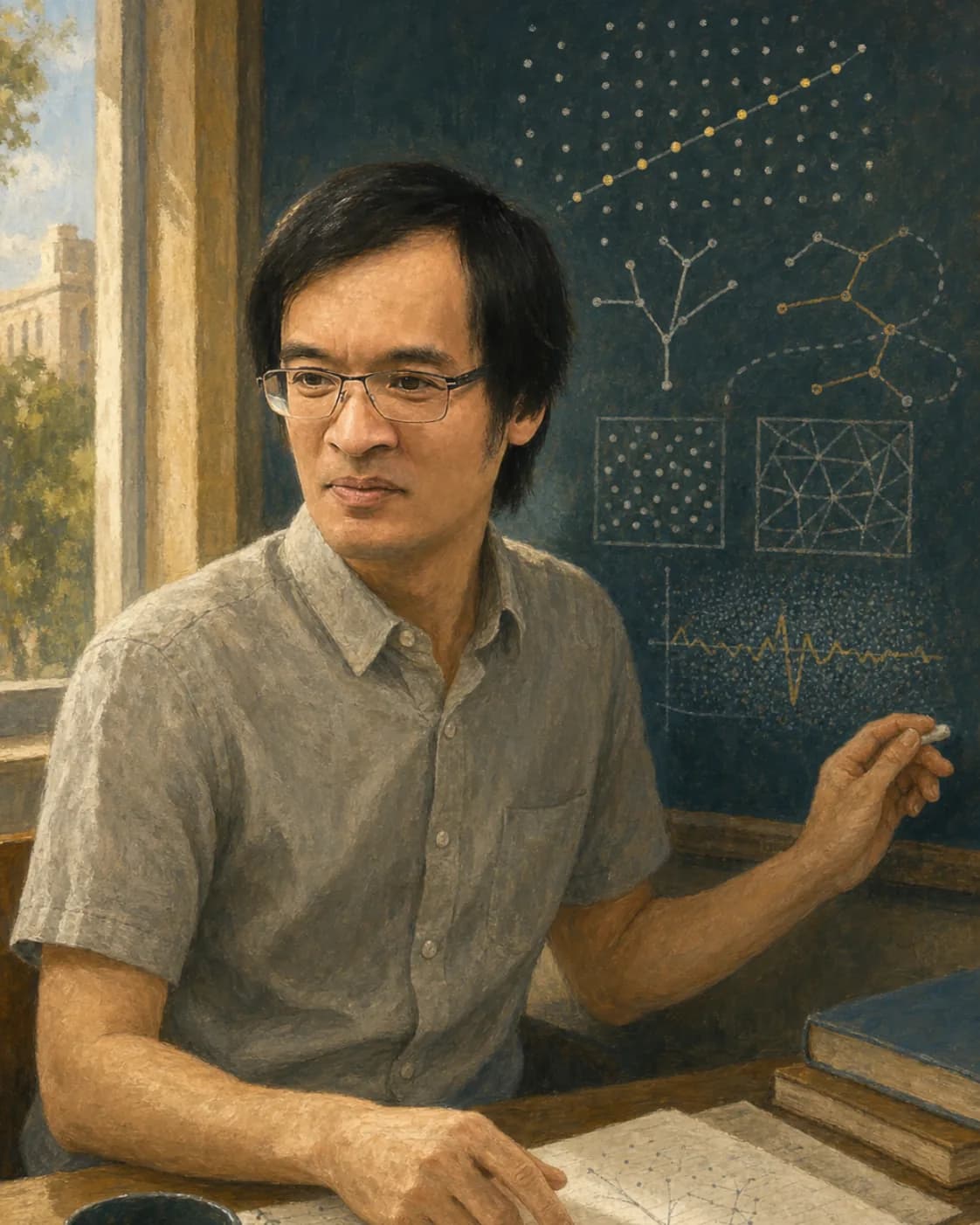
Crossing between structure and randomness through collaboration
The face uses a current public photograph of Tao as an appearance reference, but this is not a record of an actual UCLA lecture or proof session. It is a contemporary AI editorial illustration of a living person, and the board is not a literal paper or formula.
MathVoyage editorial direction · OpenAI image generation · living-person photograph reference · 2026-08-07
A mathematical scene preserving a public likeness
The idea to carry forward
When a problem resists, try separating its structured and random parts.Enter through one scene
He earned bronze in Warsaw in 1986, silver in Havana in 1987, and gold in Canberra in 1988, setting the youngest-gold record.
Questions this person helps open
These are reverse projections of existing editorial routes, not claims of direct influence or sole invention.
Through Twin Prime Conjecture: How can we find hidden order without counting everything?
Through Collatz Conjecture: How can we find hidden order without counting everything?
PROFILE 02 · DEEP VOYAGE
Instead of memorizing more dates, follow the world that shaped this mind, the scenes that changed its direction, and the questions carried onward.
CHAPTER 01 · PERSON AND PERIOD
Before the finished achievement, read what this person treated as a problem and where the surviving evidence reaches its limit.
A mathematician whose collaborative work shows how techniques can move from one field into another. Tao won IMO bronze in 1986, silver in 1987, and gold in 1988, setting the youngest-gold record. Rather than making embellished childhood anecdotes explain his work, follow the research after his 1996 Princeton doctorate across harmonic analysis, partial differential equations, combinatorics, and analytic number theory. With Ben Green he proved that the primes contain arbitrarily long arithmetic progressions, and collaborations have ranged through compressed sensing, nonlinear Schrödinger equations, and structure versus randomness in sequences. His official 2006 Fields Medal citation likewise emphasized achievements joining several areas. His blog and Polymath work expose conjectures, failed routes, and partial progress as part of how mathematics grows collectively.
CHAPTER 02 · TURNING SCENES
Follow the moments when the idea moved one step further. Every scene continues through an evidenced place or an honestly labelled time context.
Scene 1 / 4
He earned bronze in Warsaw in 1986, silver in Havana in 1987, and gold in Canberra in 1988, setting the youngest-gold record.
Scene 2 / 4
After a Princeton doctorate in harmonic analysis, he began research and teaching at UCLA across several interacting fields.
Scene 3 / 4
With Ben Green he proved that the primes contain arbitrarily long arithmetic progressions. Pseudorandomness and transference were key to moving ideas related to Szemerédi’s theorem into the sparse primes.
Scene 4 / 4
He was recognized for contributions to partial differential equations, combinatorics, harmonic analysis, and additive number theory.
THOUGHT EXPERIMENT · NOT A FACT CLAIM
This is a thought experiment about influence, not a verified historical fact.
Beginners search for prime arithmetic progressions such as 5, 11, 17. Intermediate learners compare structure and randomness in long sequences. Advanced learners meet the transference principle and harmonic-analysis tools behind Green–Tao. Experts compare how Gowers uniformity norms, ergodic methods, and the circle method capture related structure.
Curated sources and problems. Bring one discovery back from OEIS, Project Euler, MathOverflow, or arXiv.