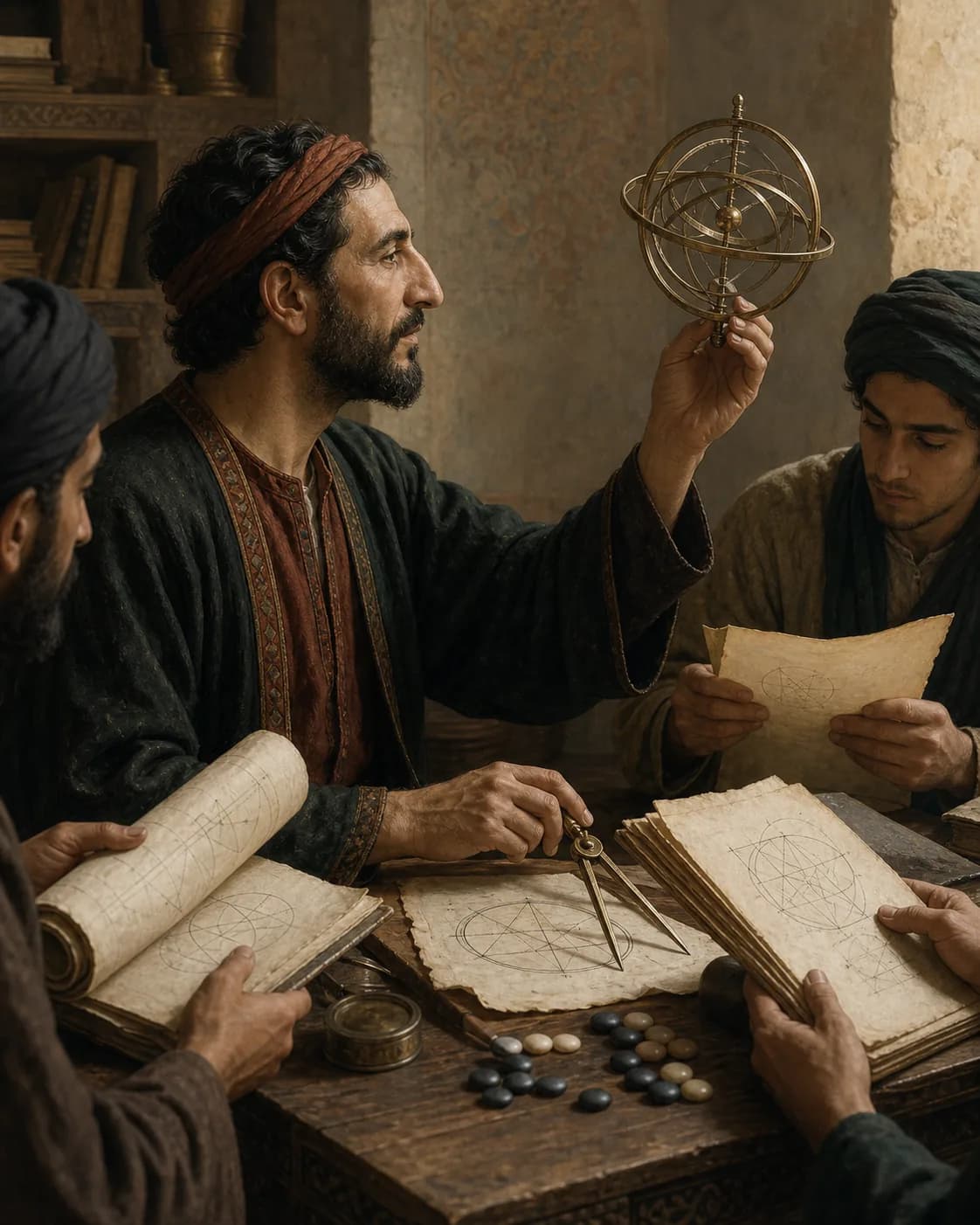
Thabit ibn Qurra
Life
A scholar from Harran who linked translation, revision, and new theorems in one practice. Thabit worked in Syriac and Arabic and developed expertise in Greek mathematical and astronomical texts. Through the patronage network of the Banu Musa, he worked in Baghdad translating or revising texts in the traditions of Euclid, Archimedes, Apollonius, and Ptolemy. It is safer to describe a network of patrons, translators, and scribes than to assign him the modern-style post of a core “House of Wisdom member.” In number theory he gave a theorem producing an amicable pair when three associated numbers are prime; it does not prove infinitely many pairs. He also wrote original works in geometry, astronomy, and mechanics, and later members of his family took part in Baghdad mathematics.
Decisive moments
Entering Baghdad through the Banu Musa network
BaghdadAfter connecting with the Banu Musa, he moved to Baghdad and worked on translation, revision, and research. The key setting was a patronage network of multilingual scholars, not one simple institutional post.
Thabit's theorem — generalising amicable numbers
BaghdadHe gave sufficient conditions that produce an amicable pair when three related numbers are all prime. The theorem does not say that infinitely many inputs satisfy those conditions.
Extending geometry while translating its proofs
BaghdadWhile translating and revising geometry in the Euclidean and Archimedean traditions, he also wrote original work on areas, ratios, and parabolic problems. The continuity of problems and proofs is more informative than assigning one later formula a single first inventor.
If this person hadn't existed
This is a thought experiment about influence, not a verified historical fact.
Beginners verify that the proper divisors of 220 and 284 sum to the other number. Intermediate learners test the prime conditions in Thabit’s theorem. Advanced learners distinguish a sufficient construction from a proof of infinitely many pairs. Experts compare Greek, Syriac, and Arabic textual traditions to study how translation both preserved and transformed mathematics.
Beyond MathVoyage
Loading…