Central anchor2/11
Bayes' Theorem
Through Bayes' Theorem: How can repeated signals emerge from a single uncertain event?
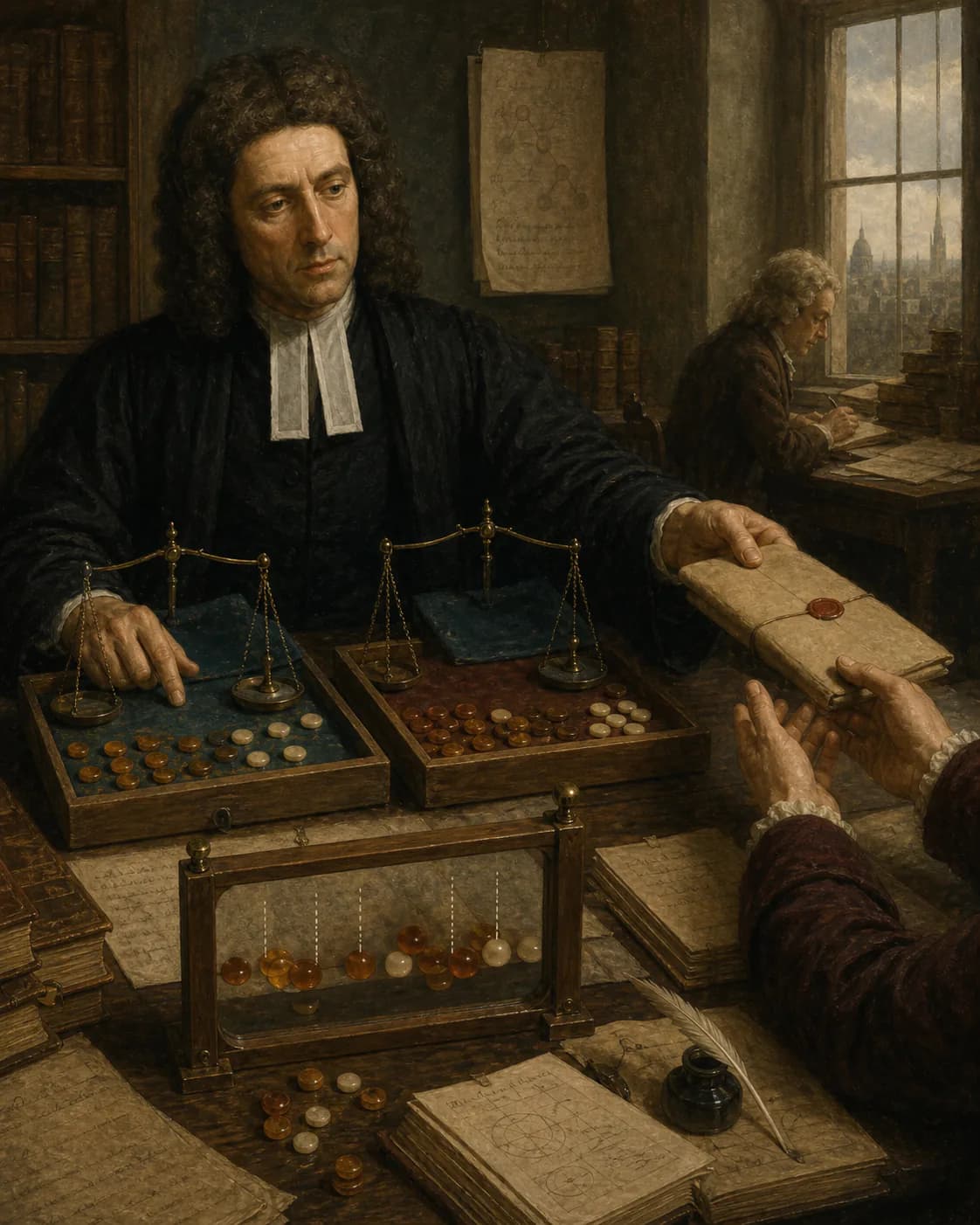
Inferring hidden possibilities from results as a manuscript moves after death
No authenticated portrait of Thomas Bayes is known. The doubtful image first printed in 1936 was not used, and the face is an explicit modern interpretation. The scene separates Bayes's specific inverse-probability problem, Richard Price's 1763 editing and introduction, and Laplace's later generalization rather than attributing all modern Bayesian statistics to one person.
MathVoyage editorial direction · OpenAI image generation · no likeness reference · doubtful 1936 image excluded · explicit invented face · 2026-08-07
Remember the mind, not only the dates
The idea to carry forward
Normalize prior assumption × likelihood of the data to obtain the posterior distribution.Enter through one scene
A Nonconformist minister in Tunbridge Wells, Bayes had studied in Edinburgh, anonymously published a book on fluxions in 1736, and became a Fellow of the Royal Society in 1742. His combined ministerial and mathematical career was not that of an isolated genius with zero publications.
Questions this person helps open
These are reverse projections of existing editorial routes, not claims of direct influence or sole invention.
Through Bayes' Theorem: How can repeated signals emerge from a single uncertain event?
Through Probabilistic Graphical Models: How can repeated signals emerge from a single uncertain event?
Why can thousands of trials be predictable when one trial is not?
PROFILE 02 · DEEP VOYAGE
Instead of memorizing more dates, follow the world that shaped this mind, the scenes that changed its direction, and the questions carried onward.
CHAPTER 01 · PERSON AND PERIOD
Before the finished achievement, read what this person treated as a problem and where the surviving evidence reaches its limit.
A minister and mathematician who asked how observed outcomes could reveal the unknown success probability of a trial. After Bayes died in 1761, Richard Price edited his manuscript and presented it to the Royal Society in 1763. The paper addressed a special inverse-probability problem: after observing successes and failures in binomial trials with unknown success probability, what is the probability that the parameter lies in a given interval? Rather than treating it as the one-time invention of every modern form of Bayes’s rule, it is more accurate to see it as an important solution under an assumption corresponding to a uniform prior. Laplace later developed inverse probability much more generally. Nor did Bayes publish no mathematics in his lifetime: in 1736 he anonymously issued a book defending the method of fluxions, and he became a Fellow of the Royal Society in 1742. The most engaging route is not to attach his name directly to every modern application, but to calculate how prior assumptions, likelihood, and a posterior distribution interact.
CHAPTER 02 · TURNING SCENES
Follow the moments when the idea moved one step further. Every scene continues through an evidenced place or an honestly labelled time context.
Scene 1 / 3
A Nonconformist minister in Tunbridge Wells, Bayes had studied in Edinburgh, anonymously published a book on fluxions in 1736, and became a Fellow of the Royal Society in 1742. His combined ministerial and mathematical career was not that of an isolated genius with zero publications.
Scene 2 / 3
Price edited the manuscript and communicated it to the Royal Society. It asks for an interval distribution of an unknown success probability after observing successes and failures, under an assumption corresponding to a uniform prior. Price’s introduction must be distinguished from Bayes’s text.
Scene 3 / 3
From the 1770s, Laplace independently developed inverse-probability methods and presented a broader framework in his 1812 treatise. The modern rule took shape within this extended tradition rather than through Bayes alone.
THOUGHT EXPERIMENT · NOT A FACT CLAIM
This is a thought experiment about influence, not a verified historical fact.
Beginners infer which of two boxes was chosen from the color drawn. Intermediate learners compute posterior probabilities from a conditional-probability table. Advanced learners plot a beta–binomial model as observations update a prior. Experts compare prior choice, exchangeability, decision theory, and frequentist procedures without reducing them to two hostile camps.
STANDING ON SHOULDERS · EVIDENCED CONNECTIONS
We do not draw a line merely because two people shared an era. Only connections traced through works, problems, or teaching appear with an explanation and evidence.
Thomas Bayes
Enlightenment
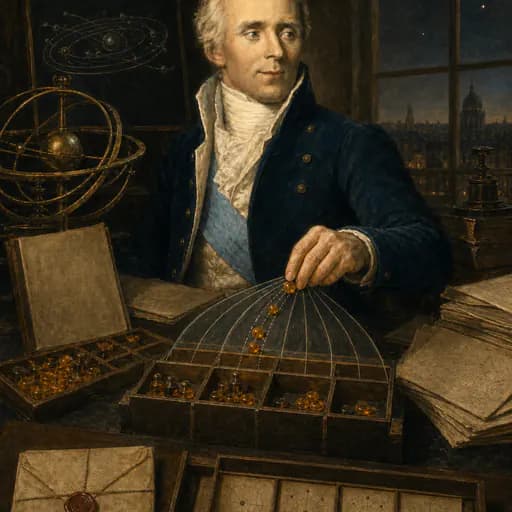
A posthumous essay becomes a general method of inference
After Bayes’s posthumous essay posed inverse probability, Laplace independently rediscovered and expanded the idea into a general method across astronomy and statistics.
Evidence for this connectionCurated sources and problems. Bring one discovery back from OEIS, Project Euler, MathOverflow, or arXiv.