Central anchor5/18
Vector Calculus
Through Vector Calculus: How can instantaneous change and long accumulation become one language?
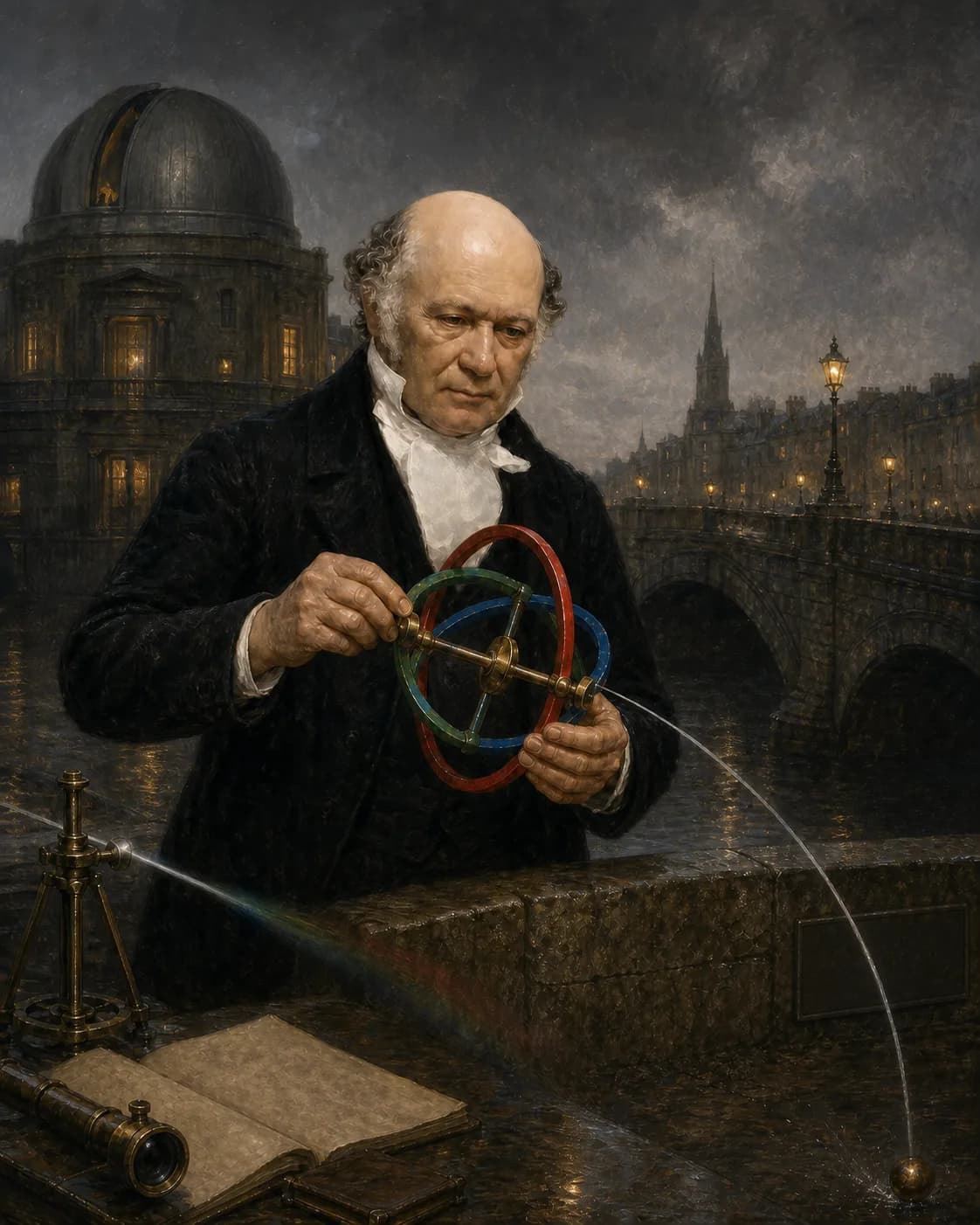
Giving up commutative order to calculate rotation
The face uses a surviving late-life photograph. The bridge scene compresses Hamilton's later recollection of the 1843 quaternion insight with optics and mechanics; it does not claim the original inscription survives or that quaternions alone created modern 3D graphics.
MathVoyage editorial direction · OpenAI image generation · historical photograph identity reference · precise generated-text removal edit · 2026-08-07
Remember the mind, not only the dates
The idea to carry forward
i² = j² = k² = ijk = −1.Enter through one scene
In 1827 he introduced the characteristic function in optics (Theory of Systems of Rays), and in 1834–35 he extended the idea to mechanics in On a General Method in Dynamics, unifying Newtonian and Lagrangian mechanics under a single function — the Hamiltonian. A century later it would be the language of quantum mechanics.
Questions this person helps open
These are reverse projections of existing editorial routes, not claims of direct influence or sole invention.
Through Vector Calculus: How can instantaneous change and long accumulation become one language?
How can one table hold a rule that moves many numbers at once?
PROFILE 02 · DEEP VOYAGE
Instead of memorizing more dates, follow the world that shaped this mind, the scenes that changed its direction, and the questions carried onward.
CHAPTER 01 · PERSON AND PERIOD
Before the finished achievement, read what this person treated as a problem and where the surviving evidence reaches its limit.
An Irish mathematician and astronomer who developed characteristic functions in optics and mechanics. After years of trying to extend complex numbers to triples, he recalled discovering the four-component quaternion relation at Broom Bridge in 1843 and carving it into the stone. Quaternions later became one useful tool for representing rotations.
CHAPTER 02 · TURNING SCENES
Follow the moments when the idea moved one step further. Every scene continues through an evidenced place or an honestly labelled time context.
Scene 1 / 3
In 1827 he introduced the characteristic function in optics (Theory of Systems of Rays), and in 1834–35 he extended the idea to mechanics in On a General Method in Dynamics, unifying Newtonian and Lagrangian mechanics under a single function — the Hamiltonian. A century later it would be the language of quantum mechanics.
Scene 2 / 3
While walking with his wife, he realized that four components and noncommutative multiplication could work where triples had failed. His own recollection says he carved i² = j² = k² = ijk = −1 into the bridge stone.
Scene 3 / 3
The first book to formalize a number system where ab ≠ ba. It opened the great current of 19th-century abstract algebra.
THOUGHT EXPERIMENT · NOT A FACT CLAIM
This is a thought experiment about influence, not a verified historical fact.
The surprise is not merely adding a dimension. Giving up ab = ba makes compositions of spatial rotations natural. A learner can move from complex-plane rotations to quaternions and then compare them with rotation matrices.
Curated sources and problems. Bring one discovery back from OEIS, Project Euler, MathOverflow, or arXiv.