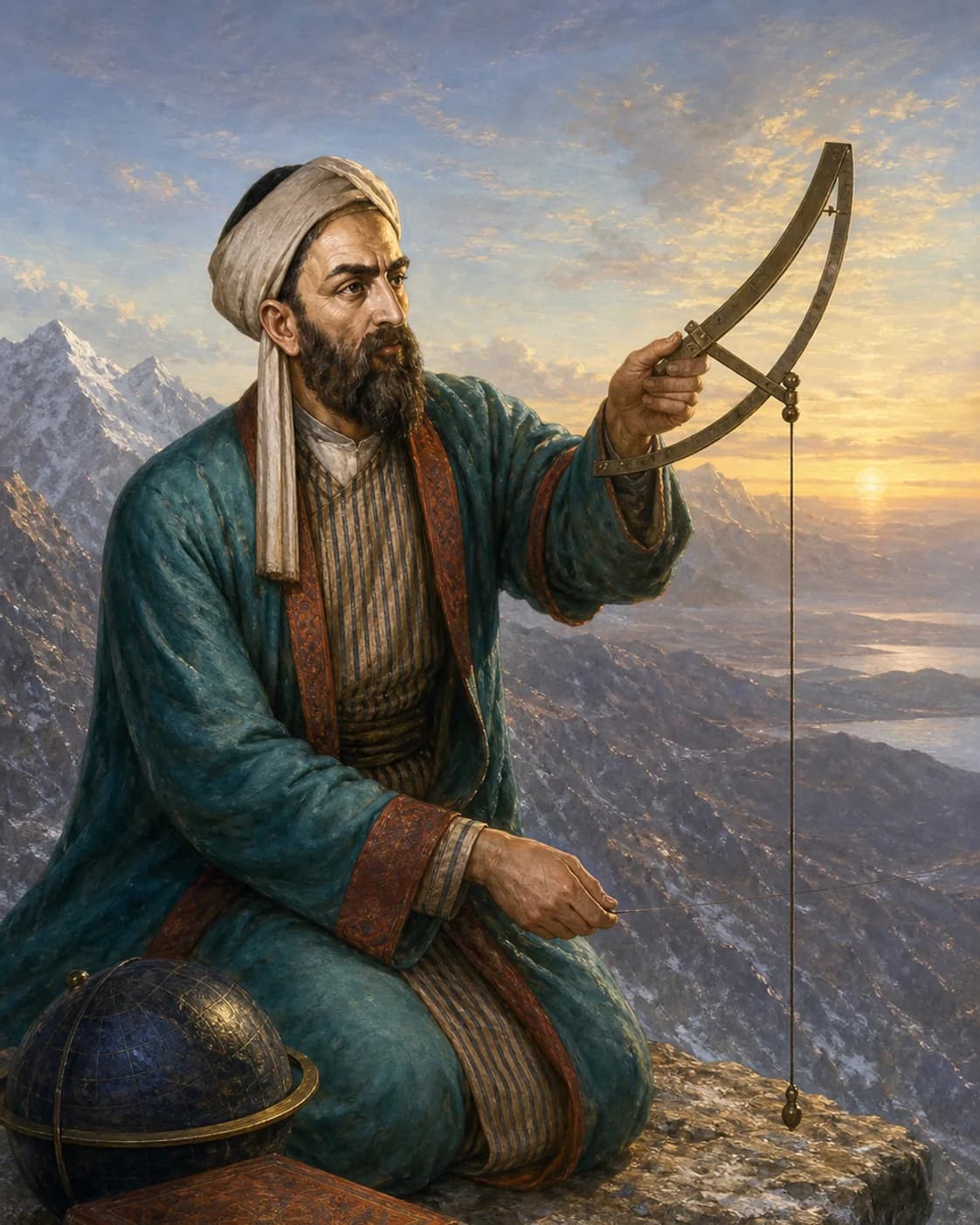
al-Biruni
Life
An eleventh-century scholar who used observation, trigonometry, and language learning as connected tools for comparing worlds. Born near Kath in Khwarezm, al-Biruni moved through several courts and scholarly networks and was taken to Ghazni after Mahmud’s conquest in 1017. The degree of coercion and his exact role in Indian campaigns require careful reading of the sources. He learned Sanskrit and wrote India, explaining Indian thought, astronomy, mathematics, and custom. Its effort to understand another tradition is remarkable, but it is not a wholly objective or uncontested “first ethnography” in the modern sense. He also described a method for finding Earth’s radius from the dip of the horizon and the height of a mountain. Modern reconstructions of a specific site and numerical accuracy depend on assumptions and manuscript readings, so the result should not be frozen as an exact 0.6 percent error. Sources also differ between a death in 1048 and evidence that he wrote after 1050, so the catalogue marks circa 1050. His achievement lies less in one miraculous measurement than in joining observation, geometry, translation, and comparison throughout a research life.
Decisive moments
Relocation to Ghazni after the conquest of Khwarezm
GhazniAfter Mahmud’s conquest he was moved into the Ghazni courtly sphere. He later studied Sanskrit and Indian learning, but the coercion of the move and his role in campaigns should not be simplified into an adventure story.
A horizon-dip method for finding Earth’s radius
NandanaHe described triangulating a mountain’s height and then measuring the dip to the horizon from its summit to calculate Earth’s radius. A reconstruction at Nandana is widely discussed, but the exact value and error percentage remain interpretation-dependent.
Kitab al-Hind — comparison through language learning
GhazniDrawing on Sanskrit materials and conversations, he described religion, philosophy, astronomy, mathematics, and custom. Its effort toward fairness should be read together with the categories and limits of an outside observer.
The Mas'udi Canon — a synthesis of observation and calculation
GhazniDedicated to Mas‘ud, this large astronomical work brought together chronology, geography, trigonometry, calculations of the Sun, Moon, and planets, and observational data. Its contents and transmission are more informative than calling it one fixed standard textbook for centuries.
If this person hadn't existed
This is a thought experiment about influence, not a verified historical fact.
Beginners sketch why the horizon appears below eye level from a mountain. Intermediate learners derive Earth’s radius from mountain height and dip angle. Advanced learners propagate errors in height, angle, and atmospheric refraction. Experts compare the translation choices and categories in India with source texts and modern scholarship, examining both the possibilities and limits of mathematically describing another culture.
Beyond MathVoyage
Loading…