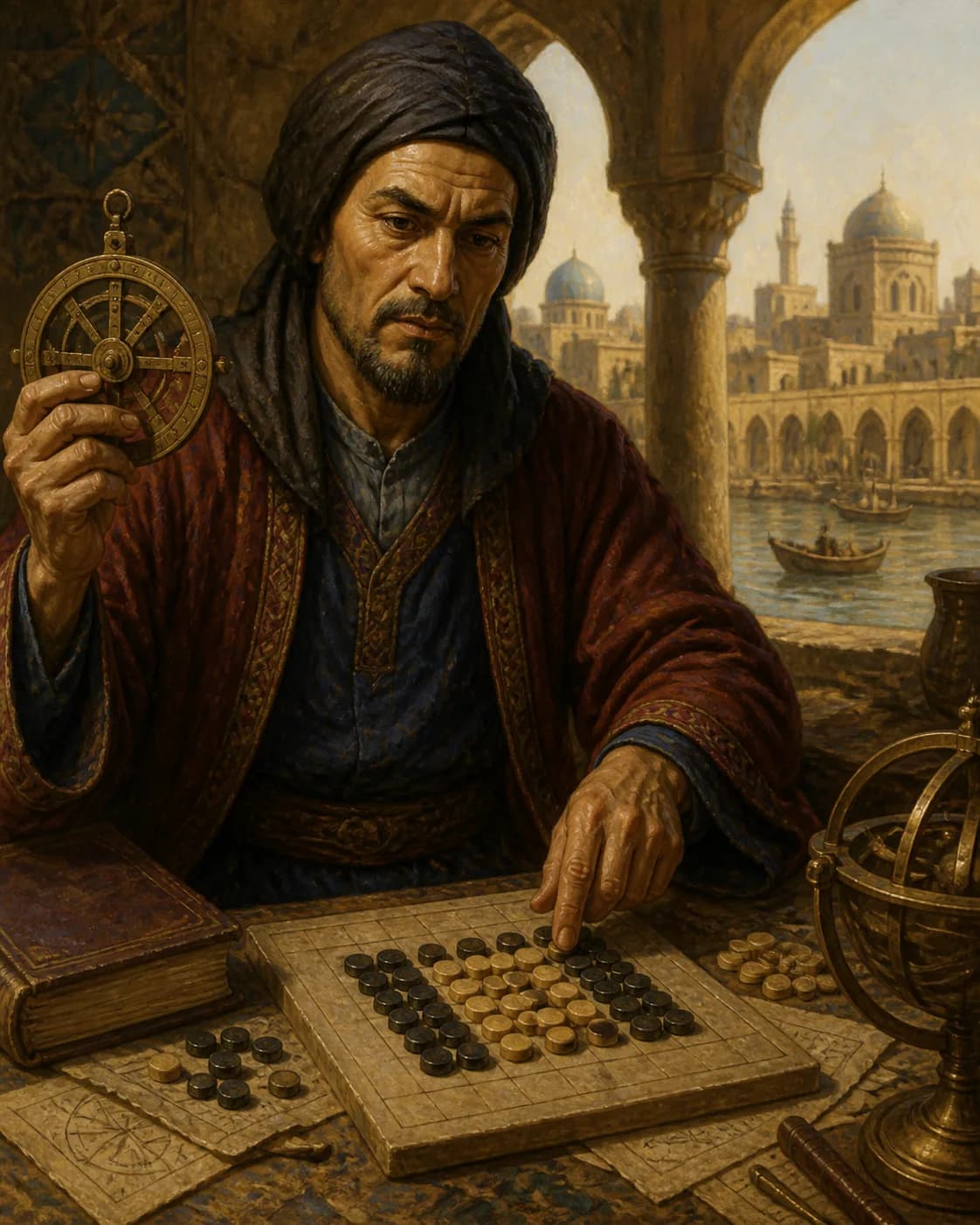
An editorial interpretation of an angular-faced, short-bearded al-Khwarizmi examining balancing counters and an astronomical instrument in a ninth-century Baghdad setting
AI editorial interpretation

Organizing equations as procedures in words and geometry

No verified lifetime portrait or exact workplace of al-Khwarizmi survives. The angular face, short beard, and low wrap use much later commemorative conventions only to distinguish him in the collection. The face, room, and tools are a modern condensation of ninth-century Baghdad patronage and practical problems in his work on completion and balancing, not evidence of his appearance.

MathVoyage editorial direction · OpenAI image generation · later commemorative iconography reference · no verified lifetime likeness · 2026-08-07

Remember the mind, not only the dates

Al-Khwarizmi

AD 780 - AD 850 (estimated)
Thinking ground · Baghdad
Islamic Golden AgeCompletion and balancingInheritance, surveying, and tradeTwo names carried by translation

The idea to carry forward

I have composed a short work on calculating by completion and balancing, confining it to what is easiest and most useful in arithmetic.

Enter through one scene

AD 813

Working in Baghdad under al-Maʾmūn

He worked on astronomy, geography, and mathematics within al-Maʾmūn's environment of library and scholarly patronage. Sparse evidence cautions against treating the House of Wisdom as a modern institute with known job titles.

Thirty seconds of moving an equationc. 825 CE · Baghdad · writing, patronage, and reader network

Can one missing square piece unlock an equation?

Al-Khwarizmi did not write with today’s x notation. He classified squares, roots, and numbers in words, restoring and balancing both sides while geometry explained why a procedure worked.

Complete the square for x² + 10x = 39.

Follow each transformation and notice why the same amount is added to both sides.

Open a stage and compare the state before and after.

Questions this person helps open

Concept ports to revisit, not another achievement list

These are reverse projections of existing editorial routes, not claims of direct influence or sole invention.

No concept port has yet been reviewed for this person.

Browse every concept route

PROFILE 02 · DEEP VOYAGE

How Al-Khwarizmi’s ideas moved

Instead of memorizing more dates, follow the world that shaped this mind, the scenes that changed its direction, and the questions carried onward.

CHAPTER 01 · PERSON AND PERIOD

What questions surrounded Al-Khwarizmi?

Before the finished achievement, read what this person treated as a problem and where the surviving evidence reaches its limit.

About 1 min readDeeply curated story

A ninth-century mathematician, astronomer, and geographer who worked under Abbasid patronage in Baghdad. His exact birthplace is unknown: the nisba al-Khwarizmi may connect him or his ancestry with Khwarazm, but it does not establish modern Khiva as his birthplace. His al-jabr wa-l-muqābala organized practical inheritance, surveying, and trade problems into six types of linear and quadratic equations explained in words and geometry. The title supplied the word algebra, while the Latin transmission of a different work on Indian calculation turned his name, Algoritmi, into algorithm. He did not invent symbolic algebra or the computer; the richer story is how translated books preserved one author in two modern words.
CHAPTER 02 · TURNING SCENES

3 turning scenes

Follow the moments when the idea moved one step further. Every scene continues through an evidenced place or an honestly labelled time context.

  1. Scene 1 / 3

    AD 813Baghdad

    Working in Baghdad under al-Maʾmūn

    He worked on astronomy, geography, and mathematics within al-Maʾmūn's environment of library and scholarly patronage. Sparse evidence cautions against treating the House of Wisdom as a modern institute with known job titles.

  2. Scene 2 / 3

    AD 820Baghdad· Geographic context

    Al-jabr — systematizing equation types

    He classified linear and quadratic equations and solved them through restoration and balancing, expressed in words and geometry rather than modern symbolic algebra.

  3. Scene 3 / 3

    AD 825Baghdad· Geographic context

    A work on Indian calculation and its Latin afterlife

    The lost work on Indian calculation is known through later Arabic tradition and a twelfth-century Latin translation. The numeral system also travelled through other texts and commercial routes.

CHAPTER 03 · IDEAS IN MOTION

Where the idea found a foothold

A city is not scenery but a condition where people, texts, institutions, and tools could meet. Each pin marks an evidenced activity window, not an entire life.

  1. 01

    Baghdad

    Research at the House of Wisdom

CHAPTER 04 · TOOLS LEFT BEHIND

What later generations used again

The useful question is not a star rating, but what remained available for solving another problem.

TOOL 01AD 820

Systematization of Algebra

Established systematic methods for solving equations; his name is the source of the word algorithm.

THOUGHT EXPERIMENT · NOT A FACT CLAIM

Erase Al-Khwarizmi from the map

This is a thought experiment about influence, not a verified historical fact.

Hindu-Arabic numerals and equation methods moved along more than one route. Al-Khwarizmi's books were especially influential nodes in that network, and their translations even generated new vocabulary for systematic calculation.

STANDING ON SHOULDERS · EVIDENCED CONNECTIONS

What arrived here, and what moved onward?

We do not draw a line merely because two people shared an era. Only connections traced through works, problems, or teaching appear with an explanation and evidence.

Al-Khwarizmi

Al-Khwarizmi

Islamic Golden Age

Received 0Passed on 1

What later generations carried onward

Fibonacci
InfluencedFibonacci

Arabic mathematics transforms European calculation

After learning Hindu-Arabic numerals and algebraic calculation in North Africa, Fibonacci’s Liber Abaci carried the al-Khwarizmi tradition into Latin Europe.

Evidence for this connection

Beyond MathVoyage

Curated sources and problems. Bring one discovery back from OEIS, Project Euler, MathOverflow, or arXiv.