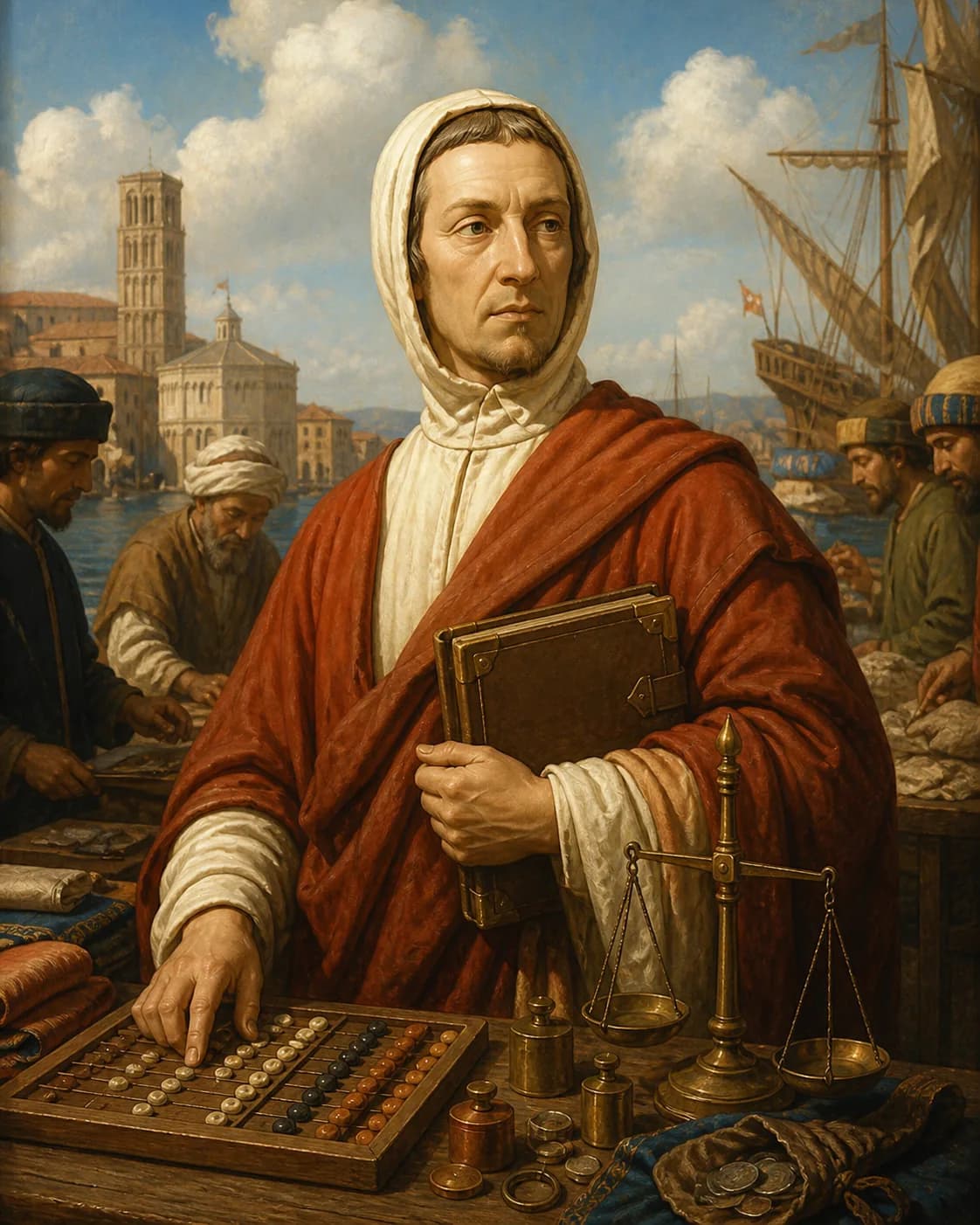
An editorial interpretation of Fibonacci, distinguished by a much later memorial statue, working with a calculation book, place-value board, exchange scale, and trade goods beside a Pisa-like harbor
AI editorial interpretation

Not a hero importing numerals, but a book arguing for useful calculation

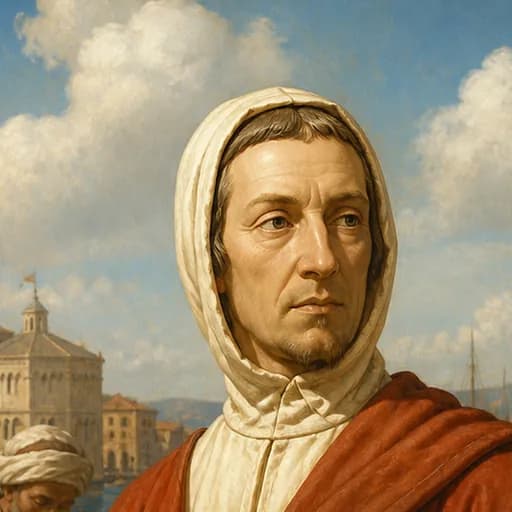
No verified lifetime portrait of Fibonacci or record of this desk survives. The hood, long face, and red mantle derive only from Giuseppe Paganucci's 1859 Pisa memorial statue, not evidence of a thirteenth-century appearance. The book, board, and scale condense commercial calculation in Liber Abaci without making it Europe's first contact, implying instant adoption, or turning the rabbit sequence into a law of nature.

MathVoyage editorial direction · OpenAI image generation · 1859 Pisa memorial statue reference · no verified lifetime likeness · 2026-08-07

Remember the mind, not only the dates

Fibonacci

AD 1170 - AD 1250 (estimated)
Thinking ground · Pisa
Medieval EuropeA practical guide to place-value calculationExchange, interest, and profit sharingA commercial network between Bugia and Pisa

The idea to carry forward

How many pairs of rabbits will be produced in a year?

Enter through one scene

AD 1192

Learning calculation in Bugia

His father represented Pisan merchants in Bugia, where Leonardo encountered local calculation and later learned from several Mediterranean traditions.

Questions this person helps open

Concept ports to revisit, not another achievement list

These are reverse projections of existing editorial routes, not claims of direct influence or sole invention.

No concept port has yet been reviewed for this person.

Browse every concept route

PROFILE 02 · DEEP VOYAGE

How Fibonacci’s ideas moved

Instead of memorizing more dates, follow the world that shaped this mind, the scenes that changed its direction, and the questions carried onward.

CHAPTER 01 · PERSON AND PERIOD

What questions surrounded Fibonacci?

Before the finished achievement, read what this person treated as a problem and where the surviving evidence reaches its limit.

About 1 min read

Leonardo of Pisa learned Mediterranean calculation practices and used Liber Abaci (1202) to explain Hindu-Arabic numerals and practical arithmetic to Latin readers. The numerals were already known in Europe and spread gradually. A Pisan record from 1241 shows that he was still alive, but not when he died; the displayed circa 1250 endpoint is a conventional editorial estimate, not a documented death year.
CHAPTER 02 · TURNING SCENES

3 turning scenes

Follow the moments when the idea moved one step further. Every scene continues through an evidenced place or an honestly labelled time context.

  1. Scene 1 / 3

    AD 1192Bugia

    Learning calculation in Bugia

    His father represented Pisan merchants in Bugia, where Leonardo encountered local calculation and later learned from several Mediterranean traditions.

  2. Scene 2 / 3

    AD 1202Pisa· Geographic context

    Liber Abaci — demonstrating practical calculation

    It taught Hindu-Arabic numerals and fractions through exchange, interest, alloy, and profit-sharing problems. Adoption proceeded gradually through manuscripts, schools, and practice.

  3. Scene 3 / 3

    AD 1202Pisa· Geographic context

    The rabbit problem and a sequence’s long afterlife

    The rabbits were one small exercise, and the same recurrence appears earlier in Indian prosody. Its exact limiting link to the golden ratio was studied later.

THOUGHT EXPERIMENT · NOT A FACT CLAIM

Erase Fibonacci from the map

This is a thought experiment about influence, not a verified historical fact.

Liber Abaci was not the one gate through which zero and Hindu-Arabic numerals entered Europe. It was an unusually influential Latin textbook within broader networks of translation, trade, and teaching, and adoption varied over centuries.

STANDING ON SHOULDERS · EVIDENCED CONNECTIONS

What arrived here, and what moved onward?

We do not draw a line merely because two people shared an era. Only connections traced through works, problems, or teaching appear with an explanation and evidence.

Fibonacci

Fibonacci

Medieval Europe

Received 1Passed on 0

What this person received

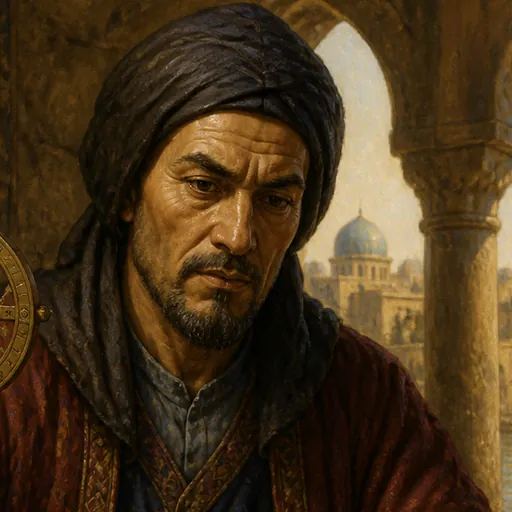
Al-Khwarizmi
Influenced byAl-Khwarizmi

Arabic mathematics transforms European calculation

After learning Hindu-Arabic numerals and algebraic calculation in North Africa, Fibonacci’s Liber Abaci carried the al-Khwarizmi tradition into Latin Europe.

Evidence for this connection

Beyond MathVoyage

Curated sources and problems. Bring one discovery back from OEIS, Project Euler, MathOverflow, or arXiv.