Another viewpoint1/5
Computability
If a procedure is exact, will it eventually solve every question?
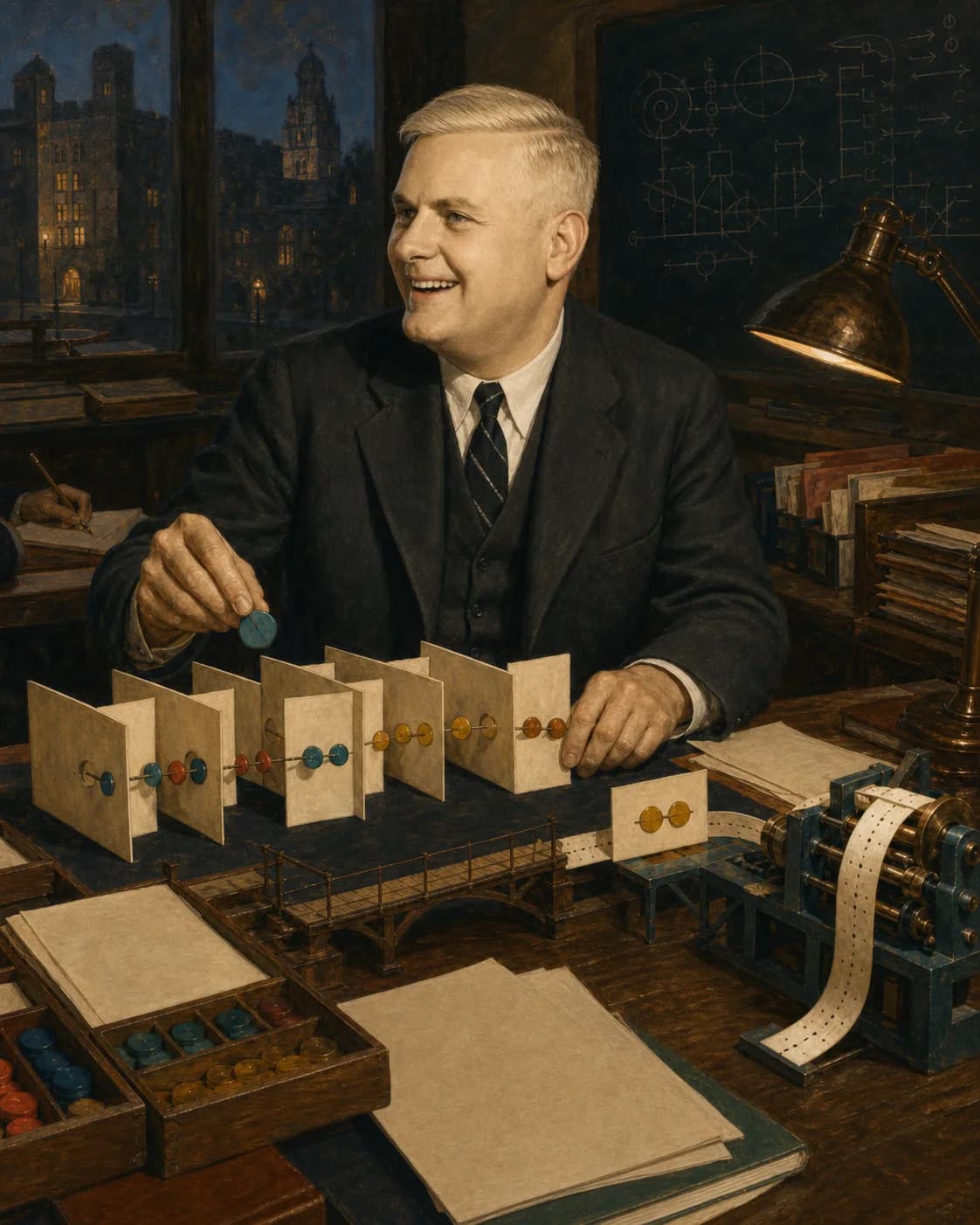
Turning ‘effective procedure’ into mutually translatable formalisms
Durable cues from a known later photograph are re-aged toward Church at about 33 in 1936. The cards and tape evoke lambda calculus and Turing's independent machine model. Equivalence theorems among formalisms differ from the Church–Turing thesis about intuitive effective procedures; the thesis is not a theorem of physical law. Turing's independent work preceded the supervisory relationship.
MathVoyage editorial direction · OpenAI image generation · historical photograph identity reference · age and generated-text correction · 2026-08-07
Remember the mind, not only the dates
The idea to carry forward
Computability converges in lambda-definability and Turing-computability.Enter through one scene
Papers from 1932–1933 introduced a formal system containing lambda abstraction and application. The larger logical system encountered inconsistency, while the functional calculus developed independently into today’s untyped lambda calculus.
Questions this person helps open
These are reverse projections of existing editorial routes, not claims of direct influence or sole invention.
If a procedure is exact, will it eventually solve every question?
PROFILE 02 · DEEP VOYAGE
Instead of memorizing more dates, follow the world that shaped this mind, the scenes that changed its direction, and the questions carried onward.
CHAPTER 01 · PERSON AND PERIOD
Before the finished achievement, read what this person treated as a problem and where the surviving evidence reaches its limit.
A logician who turned the ordinary phrase “computable by an algorithm” into a mathematical question where several formal systems meet. In the early 1930s Church developed lambda notation and the lambda calculus, expressing computation through functions, substitution, and reduction. In 1936 he used lambda-definability to give a negative solution to the decision problem, while Turing independently proposed an abstract machine model. The fact that these models and general recursive functions determine the same class of computable functions is a mathematical equivalence theorem. The claim that every intuitively effective procedure belongs to that class is the Church–Turing thesis, not a theorem proved from physical law. A Turing machine is also an abstract mathematical model, not a physical machine. Lambda calculus later strongly influenced functional programming and programming-language semantics, while Church helped build the logic community through journal editing and the supervision of students including Kleene, Rosser, and Turing.
CHAPTER 02 · TURNING SCENES
Follow the moments when the idea moved one step further. Every scene continues through an evidenced place or an honestly labelled time context.
Scene 1 / 4
Papers from 1932–1933 introduced a formal system containing lambda abstraction and application. The larger logical system encountered inconsistency, while the functional calculus developed independently into today’s untyped lambda calculus.
Scene 2 / 4
Using lambda-definability and recursive functions, Church showed that no general decision procedure exists. Turing independently reached the same negative conclusion with a machine model, and equivalences among the formal models were then established.
Scene 3 / 4
Founded the Journal of Symbolic Logic in 1936 and edited it for 43 years until 1979. The world standard venue for mathematical logic and foundations. Key papers by Turing, Gödel, Quine, Kreisel all appeared here. Succeeded as editor by Anil Nerode and Sol Feferman.
Scene 4 / 4
After completing his computability paper, Turing came to Princeton and earned his doctorate under Church in 1938 with Systems of Logic Based on Ordinals. The order matters: the independent work preceded the supervisory relationship.
THOUGHT EXPERIMENT · NOT A FACT CLAIM
This is a thought experiment about influence, not a verified historical fact.
Beginners substitute 3 into λx.x+1. Intermediate learners evaluate small programs with alpha conversion and beta reduction. Advanced learners construct translations among lambda calculus, Turing machines, and general recursive functions. Experts distinguish formal equivalence theorems from the Church–Turing thesis and explore the boundaries among undecidability, type theory, and programming-language semantics.
STANDING ON SHOULDERS · EVIDENCED CONNECTIONS
We do not draw a line merely because two people shared an era. Only connections traced through works, problems, or teaching appear with an explanation and evidence.
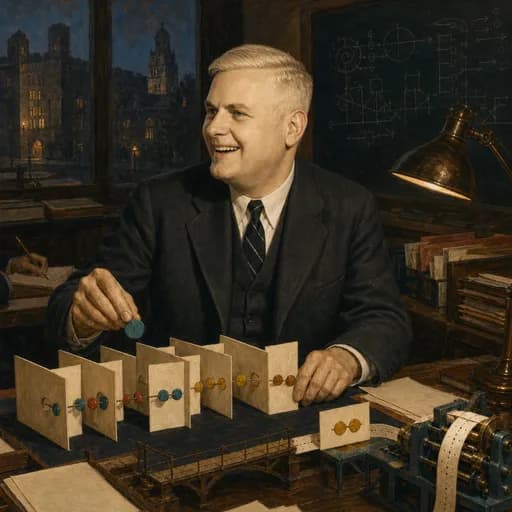
Alonzo Church
Modern Era
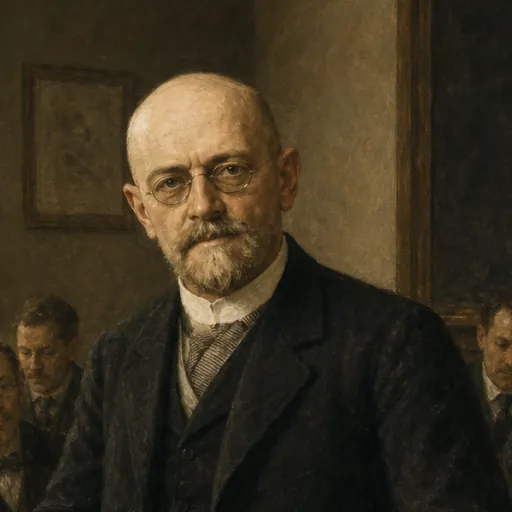
From the decision problem to lambda calculus
To answer Hilbert’s Entscheidungsproblem—whether a mechanical procedure could decide every statement—Church formalized effective calculation through lambda calculus.
Evidence for this connection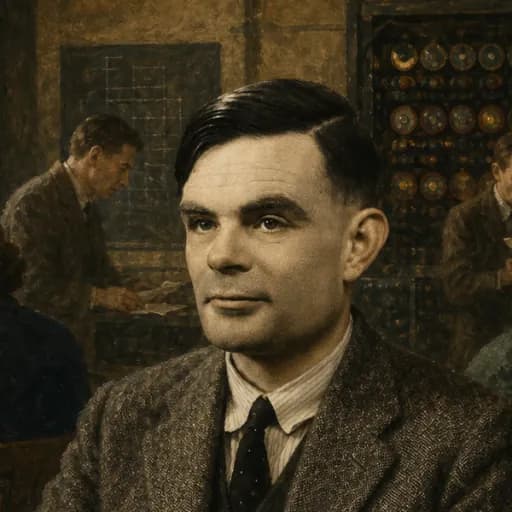
Independent theories of computation meet in doctoral study
Turing machines and Church’s lambda calculus independently captured the same boundary of computability. Turing then went to Princeton in 1936 and completed his PhD under Church.
Evidence for this connectionCurated sources and problems. Bring one discovery back from OEIS, Project Euler, MathOverflow, or arXiv.