Central anchor16/18
Complex Analysis
Why do stricter rules emerge after imaginary numbers are allowed?
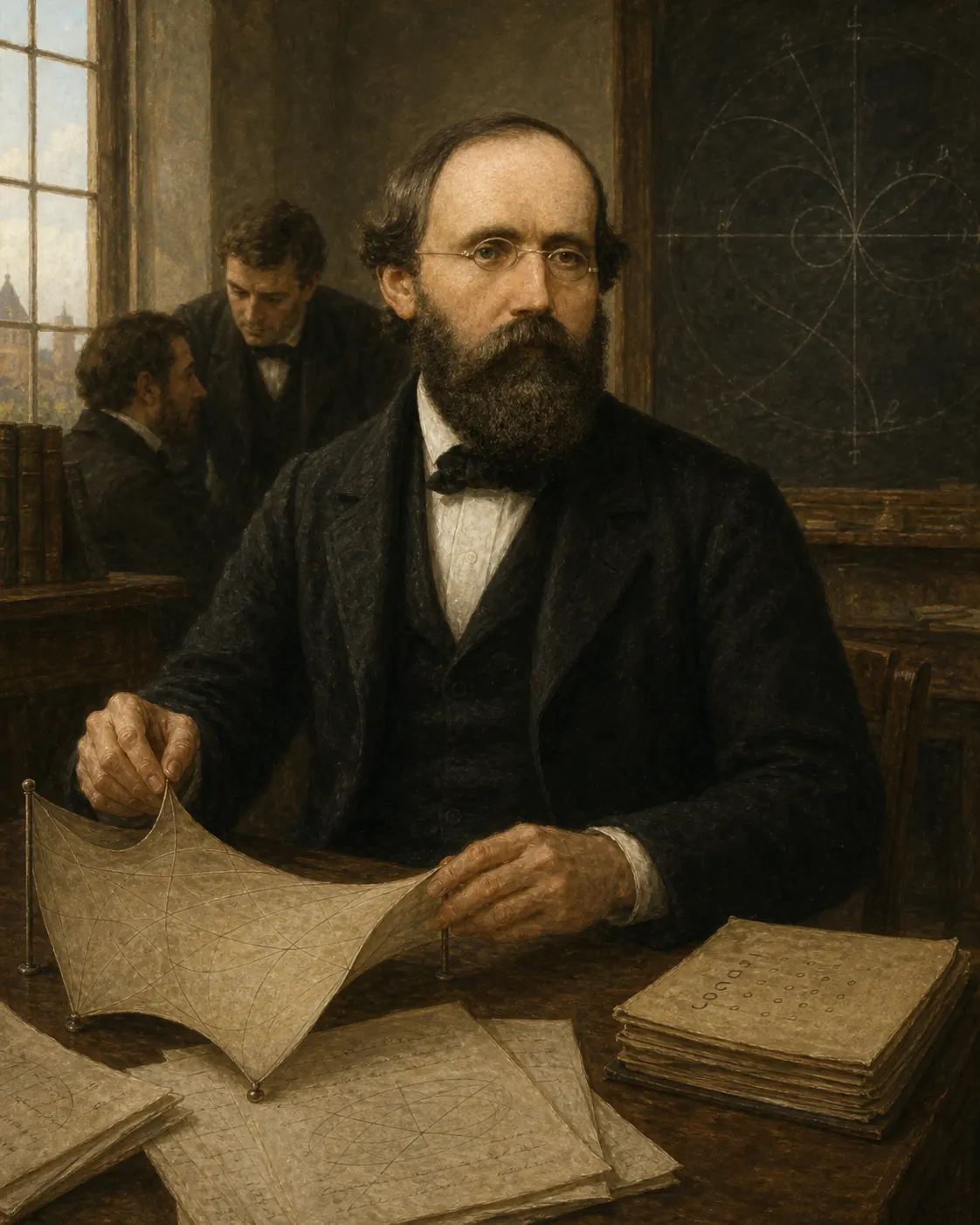
When distance can bend, space becomes a new mathematics
The face draws on surviving photographs and portrait features of Riemann, but this scene compresses his 1854 habilitation lecture and six-page 1859 paper on primes into one editorial study. The board and surface are not records of the lecture, and the scene does not rely on stories about lost theorems burned after his death.
MathVoyage editorial direction · OpenAI image generation · historical likeness reference · 2026-08-07
Remember the mind, not only the dates
The idea to carry forward
The properties which distinguish space from other conceivable triply-extended magnitudes can be deduced from experience.Enter through one scene
He discussed higher-dimensional magnitudes and curvature and asked how spatial geometry relates to experience. Gauss's reaction is known through later recollection.
Questions this person helps open
These are reverse projections of existing editorial routes, not claims of direct influence or sole invention.
Why do stricter rules emerge after imaginary numbers are allowed?
If one rule about parallel lines changes, does the shape of the universe change too?
Through Manifold: What survives when shapes change, and which rules divide one world from another?
As numbers grow, do primes fade away—or reveal a hidden order?
PROFILE 02 · DEEP VOYAGE
Instead of memorizing more dates, follow the world that shaped this mind, the scenes that changed its direction, and the questions carried onward.
CHAPTER 01 · PERSON AND PERIOD
Before the finished achievement, read what this person treated as a problem and where the surviving evidence reaches its limit.
A concise, transformative author in complex analysis, geometry, and number theory. His 1854 lecture opened higher-dimensional metric geometry; a six-page 1859 paper posed the still-open hypothesis on zeta zeros.
CHAPTER 02 · TURNING SCENES
Follow the moments when the idea moved one step further. Every scene continues through an evidenced place or an honestly labelled time context.
Scene 1 / 3
He discussed higher-dimensional magnitudes and curvature and asked how spatial geometry relates to experience. Gauss's reaction is known through later recollection.
Scene 2 / 3
He proposed that every nontrivial zeta zero has real part 1/2. However many zeros are checked numerically, that is not a proof for all infinitely many.
Scene 3 / 3
He died at 39 while seeking relief from tuberculosis. Accounts say some papers were burned during household clearing, but their contents are unknown.
CHAPTER 03 · IDEAS IN MOTION
A city is not scenery but a condition where people, texts, institutions, and tools could meet. Each pin marks an evidenced activity window, not an entire life.
University of Göttingen
CHAPTER 04 · TOOLS LEFT BEHIND
The useful question is not a star rating, but what remained available for solving another problem.
Generalized the geometry of curved spaces and supplied the mathematical foundation for Einstein's relativity.
THOUGHT EXPERIMENT · NOT A FACT CLAIM
This is a thought experiment about influence, not a verified historical fact.
Riemannian geometry became a language of general relativity and many other fields. The hypothesis asks how tightly errors in prime distribution are controlled and sharply separates finite verification from proof over an infinite set.
STANDING ON SHOULDERS · EVIDENCED CONNECTIONS
We do not draw a line merely because two people shared an era. Only connections traced through works, problems, or teaching appear with an explanation and evidence.
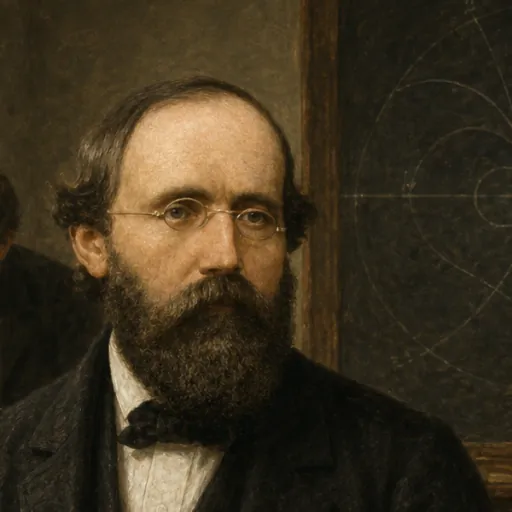
Bernhard Riemann
Nineteenth-Century Mathematics
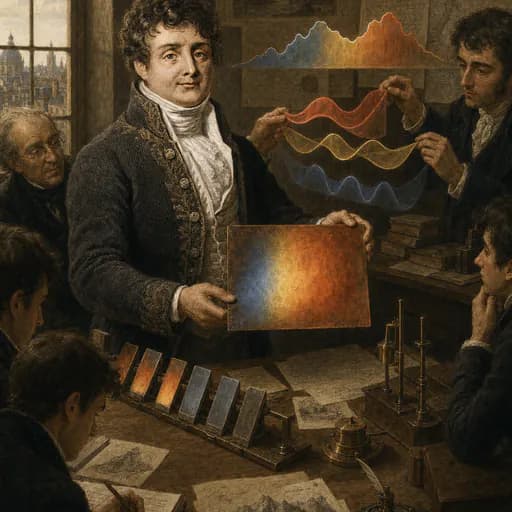
Fourier series force a new meaning of integration
Fourier’s question of which functions admit trigonometric-series representations pushed Riemann to formulate a new criterion for integrability.
Evidence for this connection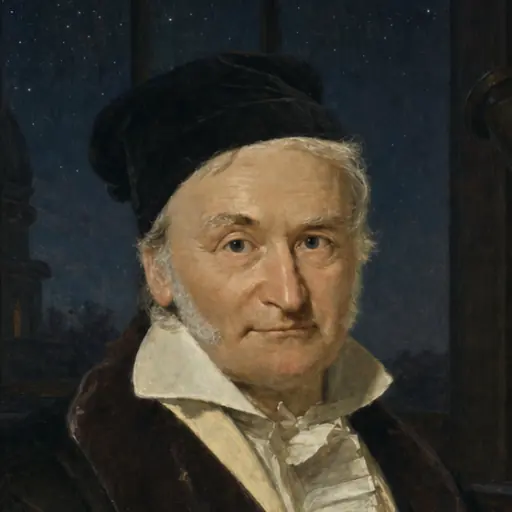
Gauss recognizes Riemann’s new geometry
Riemann completed his doctorate under Gauss and, on a topic chosen by Gauss, delivered the 1854 habilitation lecture that opened the language of curvature and manifolds.
Evidence for this connection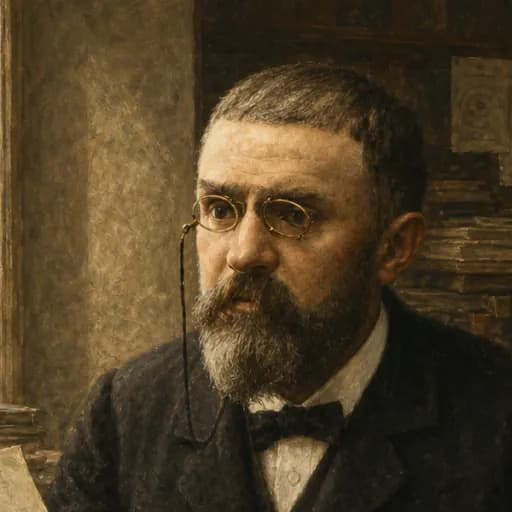
From Riemann surfaces to topology
Poincaré extended the relation between Riemann surfaces and complex functions toward higher-dimensional manifolds and topological invariants, helping found algebraic topology.
Evidence for this connection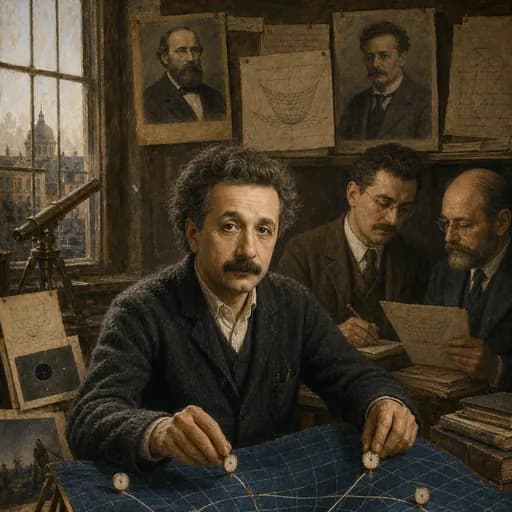
Curved space explains gravity
Riemannian metric and curvature became the mathematical language in which Einstein expressed gravitation as the curvature of spacetime.
Evidence for this connection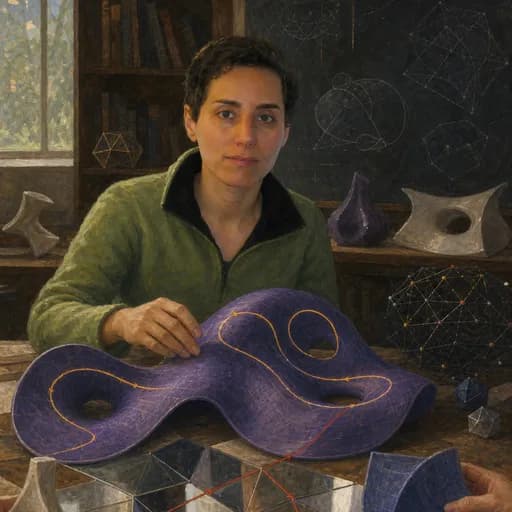
Measuring the space of Riemann surfaces itself
Mirzakhani studied not one Riemann surface but the moduli space of all such surfaces, connecting geodesics, volumes, geometry, and dynamics.
Evidence for this connectionCurated sources and problems. Bring one discovery back from OEIS, Project Euler, MathOverflow, or arXiv.