Central anchor10/11
K-Means Clustering
Through K-Means Clustering: How can repeated signals emerge from a single uncertain event?
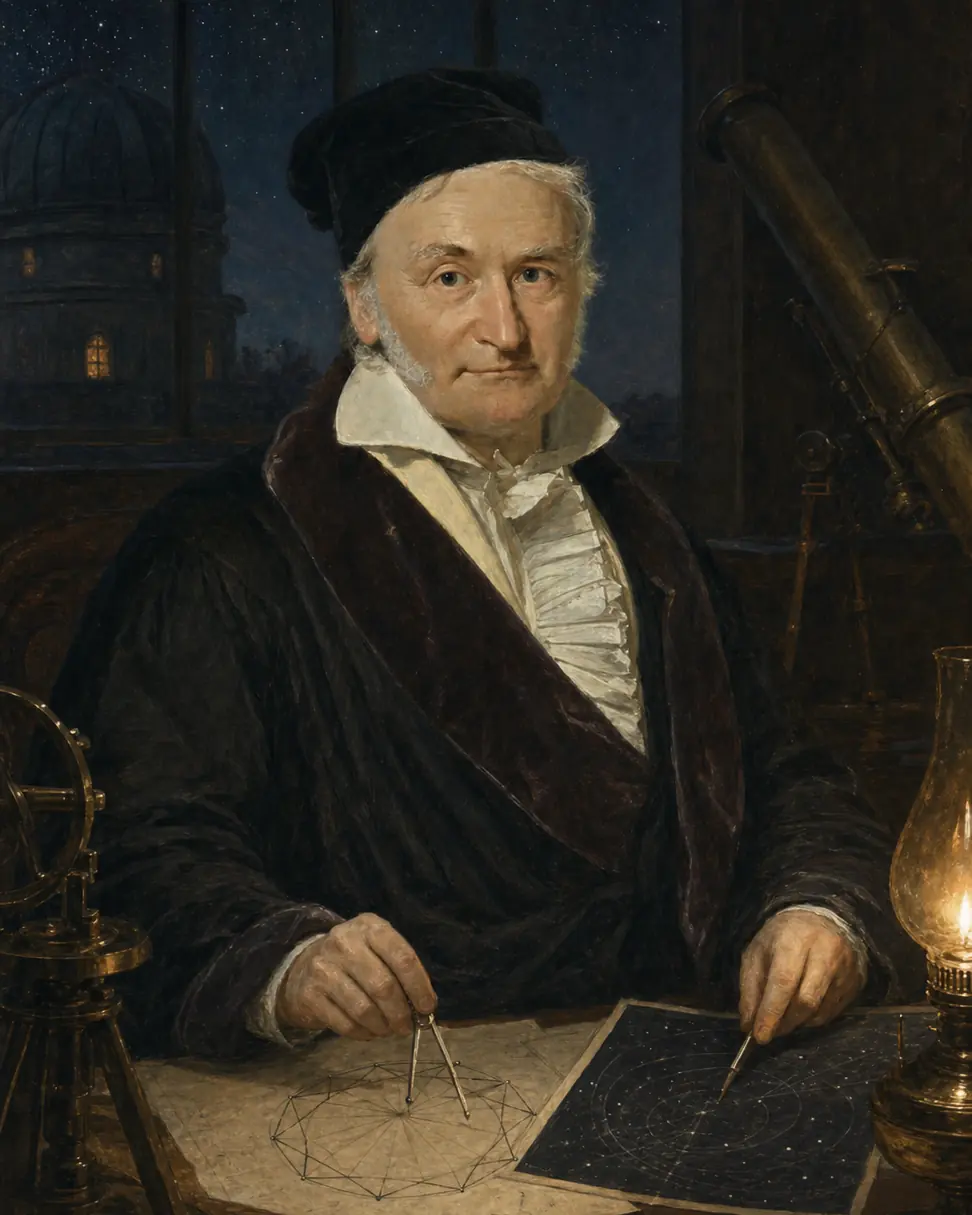
Calculating an unseen orbit from scattered observations
The face draws on the familiar Gauss portrait tradition, but this Göttingen observatory scene condenses work on the regular 17-gon, number theory, the orbit of Ceres, and geodesy from different years. It does not rely on the later schoolroom sum anecdote or claim that Gauss alone invented least squares.
MathVoyage editorial direction · OpenAI image generation · historical likeness reference · 2026-08-07
Remember the mind, not only the dates
The idea to carry forward
Mathematics is the queen of the sciences, and number theory is the queen of mathematics.Enter through one scene
He showed that the special form of 17 permits straightedge-and-compass construction of the regular 17-gon. A story says he wanted it on his gravestone, where it does not actually appear.
Questions this person helps open
These are reverse projections of existing editorial routes, not claims of direct influence or sole invention.
Through K-Means Clustering: How can repeated signals emerge from a single uncertain event?
Through Modular Arithmetic: How can we find hidden order without counting everything?
Through Prime Number Theorem: How can we find hidden order without counting everything?
As numbers grow, do primes fade away—or reveal a hidden order?
If one rule about parallel lines changes, does the shape of the universe change too?
PROFILE 02 · DEEP VOYAGE
Instead of memorizing more dates, follow the world that shaped this mind, the scenes that changed its direction, and the questions carried onward.
CHAPTER 01 · PERSON AND PERIOD
Before the finished achievement, read what this person treated as a problem and where the surviving evidence reaches its limit.
The Prince of Mathematicians. He made revolutionary contributions to nearly every field — number theory, statistics, differential geometry, electromagnetism.
CHAPTER 02 · TURNING SCENES
Follow the moments when the idea moved one step further. Every scene continues through an evidenced place or an honestly labelled time context.
Scene 1 / 4
He showed that the special form of 17 permits straightedge-and-compass construction of the regular 17-gon. A story says he wanted it on his gravestone, where it does not actually appear.
Scene 2 / 4
Published at 24, it laid the modern foundations of number theory — congruences, quadratic reciprocity, and more.
Scene 3 / 4
From Piazzi's limited observational arc he successfully predicted where Ceres would reappear. Legendre holds publication priority for least squares in 1805.
Scene 4 / 4
Letters show long private thought about non-Euclidean possibilities, but unlike Lobachevsky and Bolyai he did not publish a systematic theory.
CHAPTER 03 · IDEAS IN MOTION
A city is not scenery but a condition where people, texts, institutions, and tools could meet. Each pin marks an evidenced activity window, not an entire life.
Professor at the University of Göttingen
CHAPTER 04 · TOOLS LEFT BEHIND
The useful question is not a star rating, but what remained available for solving another problem.
A work that laid the foundations of modern number theory.
THOUGHT EXPERIMENT · NOT A FACT CLAIM
This is a thought experiment about influence, not a verified historical fact.
The point of viewing Gauss across fields is not a genius checklist. Number patterns, observational error, and surface curvature all reveal a shared habit: find structure that remains invariant beneath the data.
STANDING ON SHOULDERS · EVIDENCED CONNECTIONS
We do not draw a line merely because two people shared an era. Only connections traced through works, problems, or teaching appear with an explanation and evidence.
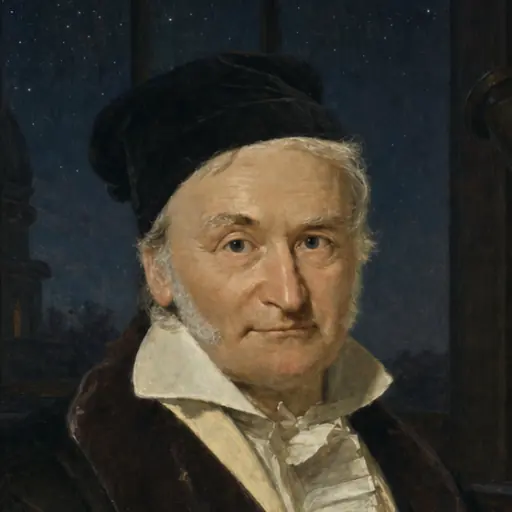
Carl Friedrich Gauss
Enlightenment
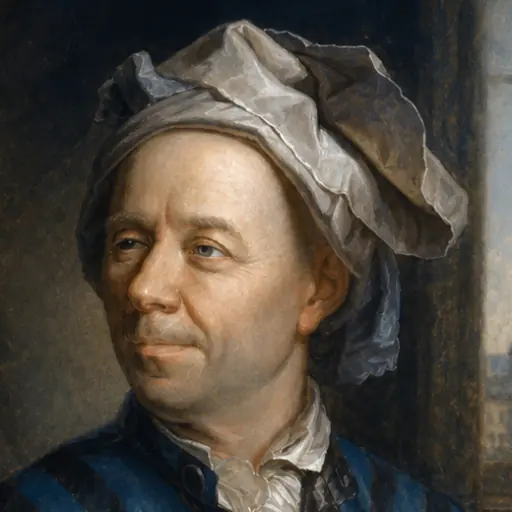
From computational number theory to structural number theory
Gauss reorganized the congruences, quadratic forms, and prime-number questions developed by Euler into the unified system of the Disquisitiones Arithmeticae.
Evidence for this connection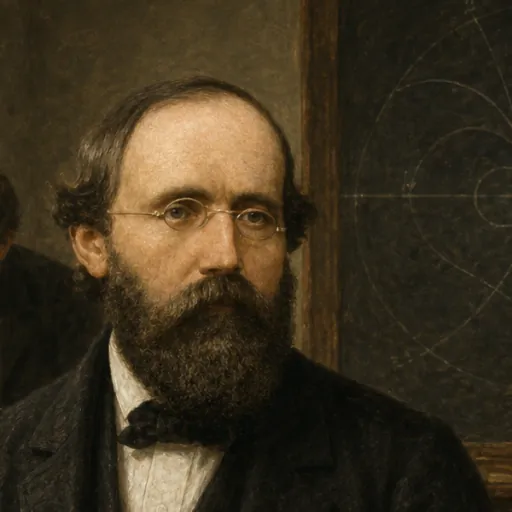
Gauss recognizes Riemann’s new geometry
Riemann completed his doctorate under Gauss and, on a topic chosen by Gauss, delivered the 1854 habilitation lecture that opened the language of curvature and manifolds.
Evidence for this connection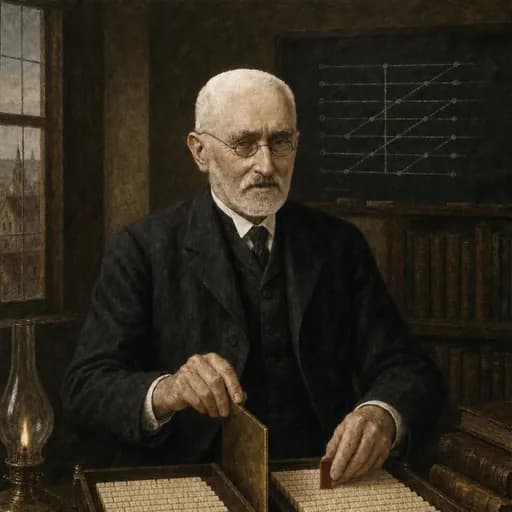
Gauss’s last doctoral student
Dedekind earned his doctorate under Gauss and became his last doctoral student, later transforming number theory through ideals and number fields.
Evidence for this connectionCurated sources and problems. Bring one discovery back from OEIS, Project Euler, MathOverflow, or arXiv.