Central anchor3/8
Lie Groups
Through Lie Groups: How can we recognize the same structure inside different problems?
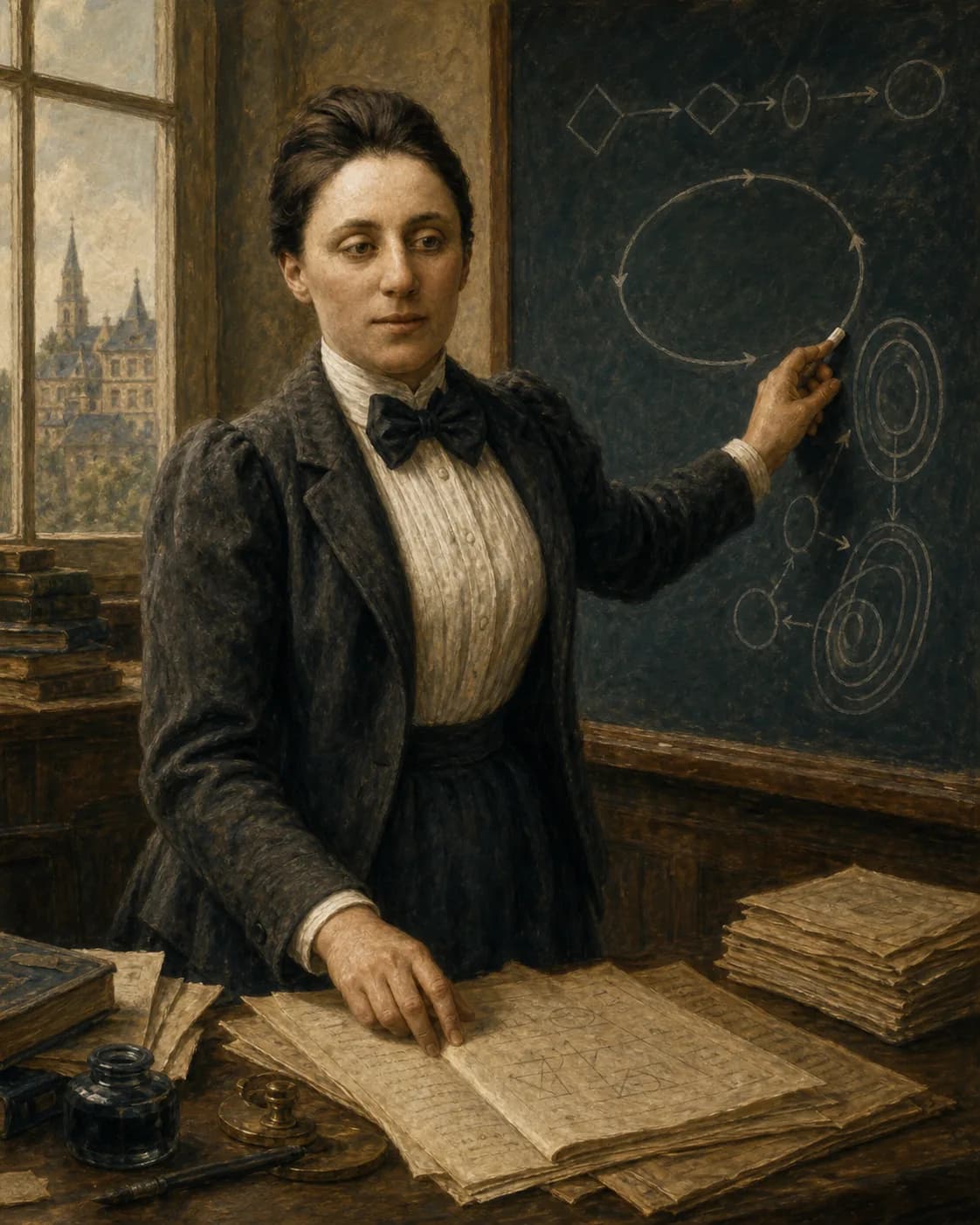
Reading conservation in symmetry and structure beyond formulas
The face draws on surviving photographs of Noether, but this board and lesson are not a record of one specific Göttingen class. The shapes are non-literal editorial cues joining her 1918 theorems with her later work in abstract algebra.
MathVoyage editorial direction · OpenAI image generation · historical photograph reference · 2026-08-07
Remember the mind, not only the dates
The idea to carry forward
My methods are working and creative methods, not technical ones.Enter through one scene
She earned a doctorate in invariant theory at Erlangen when women faced major barriers to regular study and university posts.
Noether’s turn begins by refusing to treat symmetry as visual beauty alone. If the action of a variational problem stays invariant under a continuous transformation, a corresponding conserved quantity can be derived systematically.
Which transformation pairs with which conserved quantity?
Choose three continuous symmetries and see visual sameness become a structure of physical law.
Questions this person helps open
These are reverse projections of existing editorial routes, not claims of direct influence or sole invention.
Through Lie Groups: How can we recognize the same structure inside different problems?
How can we calculate what remains while a shape changes?
PROFILE 02 · DEEP VOYAGE
Instead of memorizing more dates, follow the world that shaped this mind, the scenes that changed its direction, and the questions carried onward.
CHAPTER 01 · PERSON AND PERIOD
Before the finished achievement, read what this person treated as a problem and where the surviving evidence reaches its limit.
A central architect of modern abstract algebra whose 1918 theorems connected continuous symmetries of variational problems with conservation laws. She worked for years without a regular position, then transformed research communities in Göttingen and, after Nazi dismissal, in the United States.
CHAPTER 02 · TURNING SCENES
Follow the moments when the idea moved one step further. Every scene continues through an evidenced place or an honestly labelled time context.
Scene 1 / 3
She earned a doctorate in invariant theory at Erlangen when women faced major barriers to regular study and university posts.
Scene 2 / 3
After arriving in Göttingen in 1915, she studied invariant variational problems and published the results in 1918. The connection between continuous symmetries of an action and conserved quantities holds under explicit mathematical hypotheses.
Scene 3 / 3
Expelled from Göttingen for being Jewish, she spent her last two years at Bryn Mawr in the US.
THOUGHT EXPERIMENT · NOT A FACT CLAIM
This is a thought experiment about influence, not a verified historical fact.
Begin with the question “if the laws do not change when an experiment is shifted in time, why is energy conserved?” Then add the action, continuous transformations, and the distinct hypotheses of Noether’s first and second theorems. In algebra, the same structural habit shifts attention from isolated formulas to ideals and maps.
STANDING ON SHOULDERS · EVIDENCED CONNECTIONS
We do not draw a line merely because two people shared an era. Only connections traced through works, problems, or teaching appear with an explanation and evidence.
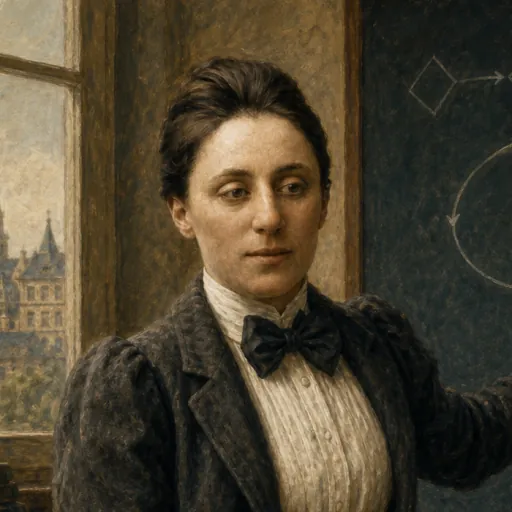
Emmy Noether
Nineteenth-Century Mathematics
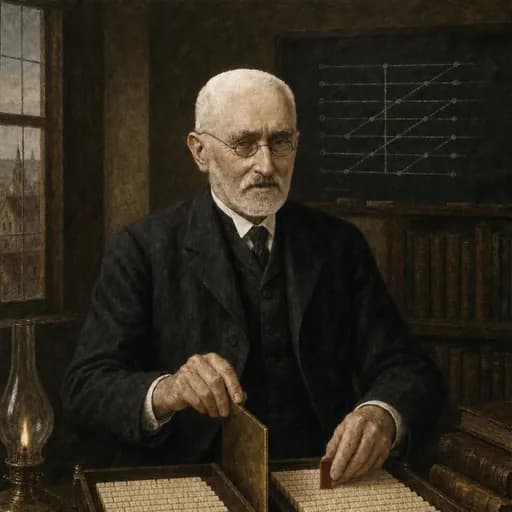
From ideals to abstract rings
Dedekind’s theory of ideals and algebraic number fields, extended through Hilbert, became a direct foundation for Noether’s axiomatic theory of rings and ideals.
Evidence for this connection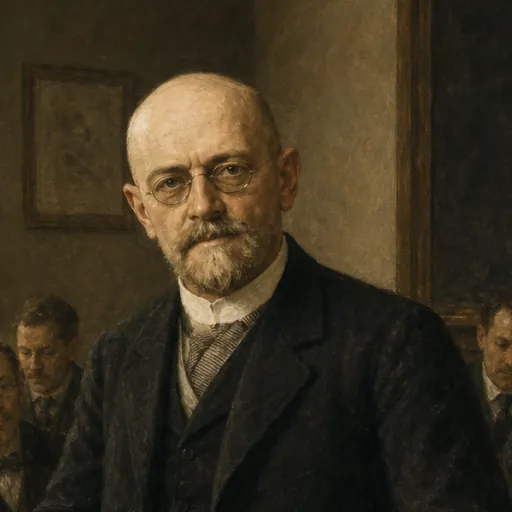
An invitation to Göttingen—and a fight to open its lecture rooms
Hilbert invited Noether to Göttingen to work on invariants in relativity and opposed rules barring women, even advertising her lectures under his own name.
Evidence for this connection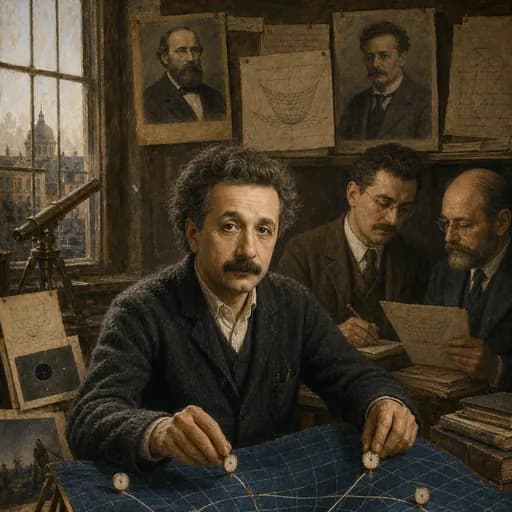
From conservation problems in relativity to Noether’s theorem
Questions about conservation in general relativity helped motivate Noether’s work, yielding the theorem linking symmetries and conservation laws across modern physics.
Evidence for this connection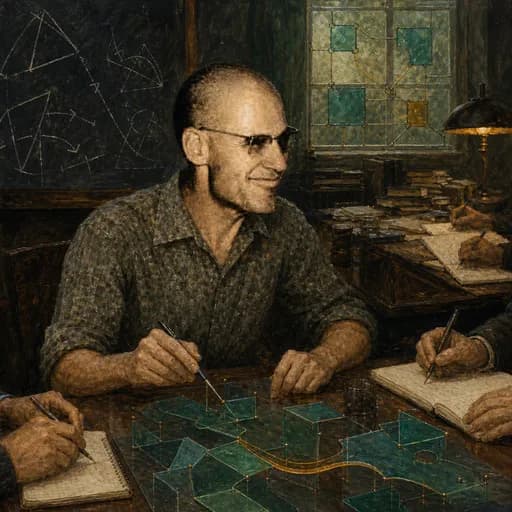
Study structures and maps, not isolated objects
Noether’s shift from element-wise calculation to structures and mappings passed through the Bourbaki tradition into Grothendieck’s category-, sheaf-, and scheme-centered geometry.
Evidence for this connectionCurated sources and problems. Bring one discovery back from OEIS, Project Euler, MathOverflow, or arXiv.