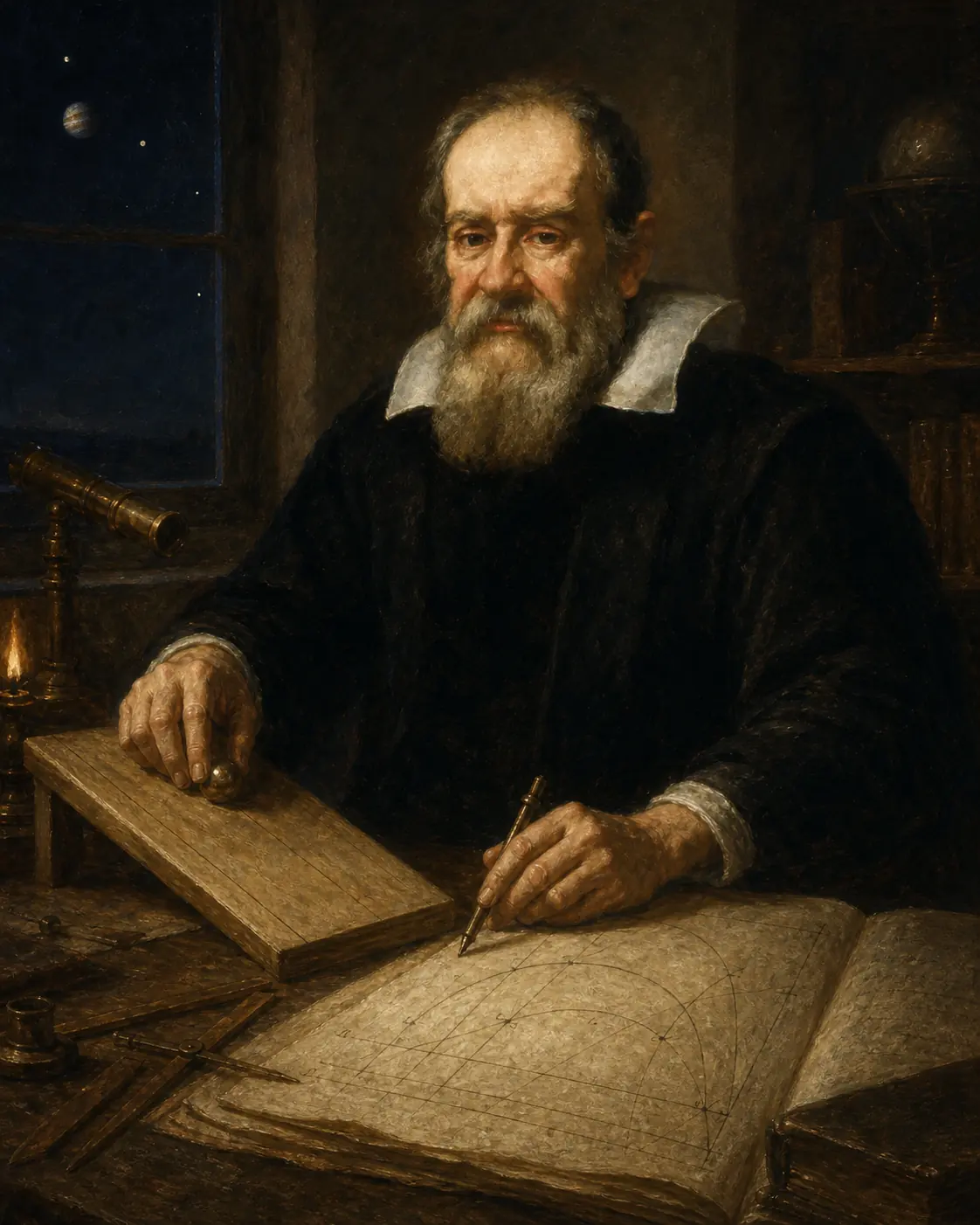
Galileo Galilei

Galileo Galilei

AD 1564 - AD 1642
Pisa
Renaissance

Life

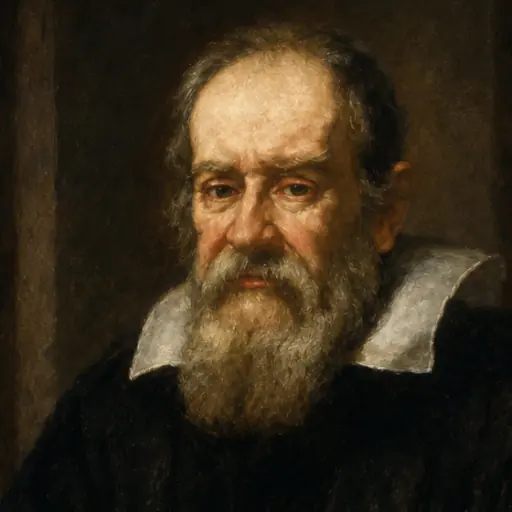
An Italian mathematician and natural philosopher who improved the recently invented telescope, observed Jupiter’s four large moons, and gave mathematical treatments of accelerated and projectile motion. His 1633 trial and house arrest were real; the phrase “and yet it moves” is a later legend.
In one line
The book of nature is written in the language of mathematics.

Decisive moments

AD 1610

Telescopic observations of Jupiter's moons

Padua

Sidereus Nuncius reported four bodies orbiting Jupiter, showing that not every celestial motion had to be centered on Earth.

AD 1632

Dialogue Concerning the Two Chief World Systems

It compared Ptolemaic and Copernican systems through a dialogue. The book and its licensing history became central to the trial the following year.

AD 1638

Two New Sciences — the math of free fall

Published while under house arrest. Distance = (1/2)gt² and other mathematical laws of motion. A direct precursor to Newtonian mechanics.

If this person hadn't existed

This is a thought experiment about influence, not a verified historical fact.

Rather than isolating Galileo as a single “father of modern science,” place him among lens makers, observers, patrons, and opponents. The key experience is comparing a verbal account of falling with a model relating time and distance.

Influence network

Influenced

Beyond MathVoyage

Loading…