Central anchor5/5
Game Theory
If my best move depends on yours, where does rationality live?
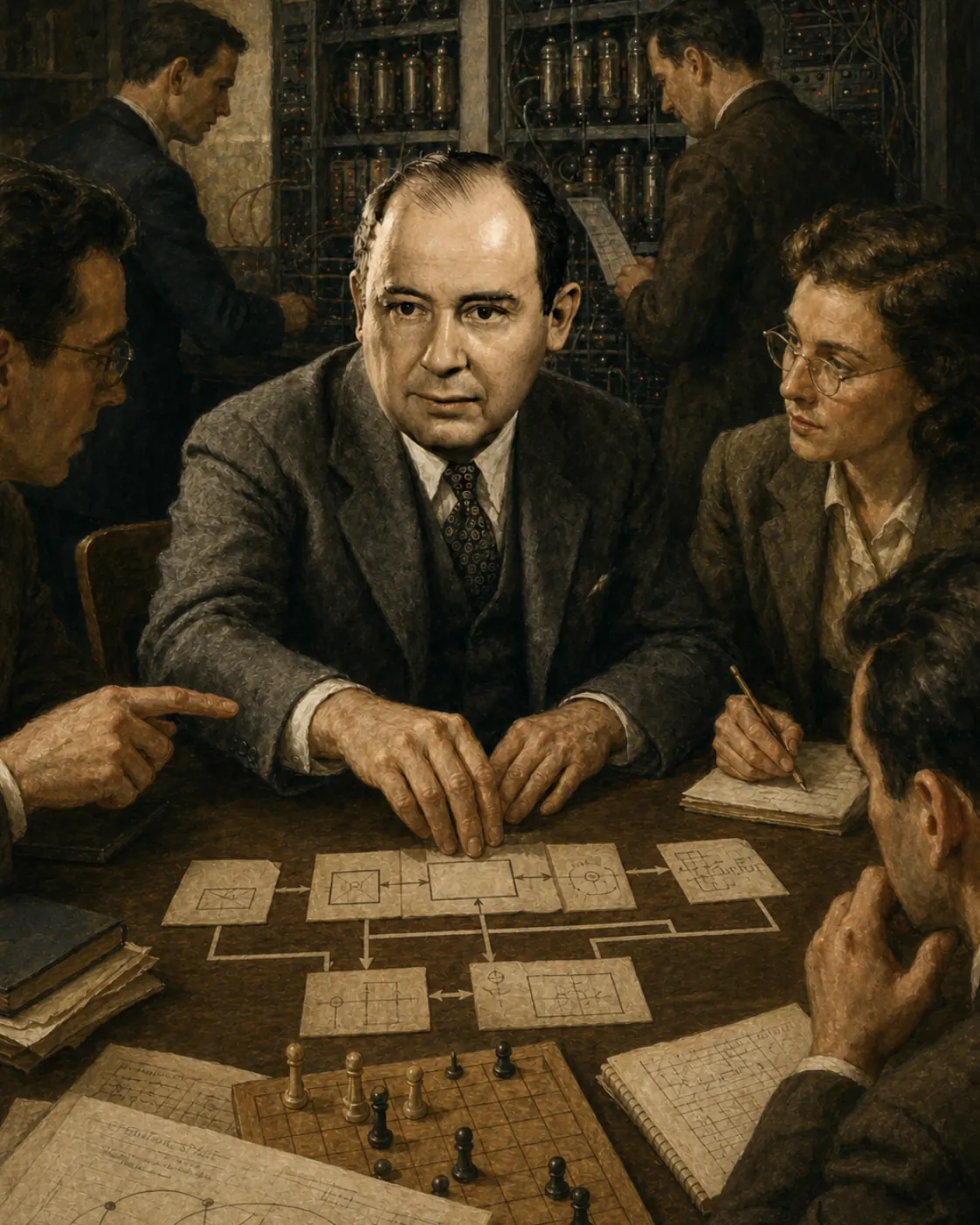
Translating distant problems into a shared structure of computation
The face draws on surviving photographs of von Neumann, but this scene compresses quantum formalism, game theory, and stored-program computing into one editorial meeting. The EDVAC report and early computers belong to a team history of engineers, programmers, and institutions; the scene does not cast von Neumann as the sole inventor of the stored-program computer or center his legacy on bomb imagery.
MathVoyage editorial direction · OpenAI image generation · historical photograph reference · 2026-08-07
Remember the mind, not only the dates
The idea to carry forward
His power lay in translating seemingly distant problems into a shared mathematical language.Enter through one scene
In 1926 he received a chemical-engineering diploma from ETH Zürich and a doctorate in mathematics from the University of Budapest, pursuing a practical family expectation alongside his mathematical work.
Questions this person helps open
These are reverse projections of existing editorial routes, not claims of direct influence or sole invention.
If my best move depends on yours, where does rationality live?
Through Monte Carlo Methods: How can repeated signals emerge from a single uncertain event?
Through Ergodic Theory: How can repeated signals emerge from a single uncertain event?
Through Linear Programming: How can we recognize the same structure inside different problems?
How can one table hold a rule that moves many numbers at once?
PROFILE 02 · DEEP VOYAGE
Instead of memorizing more dates, follow the world that shaped this mind, the scenes that changed its direction, and the questions carried onward.
CHAPTER 01 · PERSON AND PERIOD
Before the finished achievement, read what this person treated as a problem and where the surviving evidence reaches its limit.
Less a genius of one field than a mathematician who moved unusually quickly among many. Accounts by family and colleagues repeatedly describe von Neumann’s extraordinary memory and mental arithmetic, but details such as mastering calculus at eight and functional analysis at twelve are not securely documented. In 1926 he received both a chemical-engineering diploma and a doctorate in mathematics, then contributed to set theory, operator theory, and the mathematical formalism of quantum mechanics. His minimax theorem and the 1944 book with Oskar Morgenstern helped establish game theory. He worked on shock waves and implosion during the war, and his 1945 EDVAC draft spread the stored-program design. That architecture, too, belongs to a collaborative engineering history.
CHAPTER 02 · TURNING SCENES
Follow the moments when the idea moved one step further. Every scene continues through an evidenced place or an honestly labelled time context.
Scene 1 / 5
In 1926 he received a chemical-engineering diploma from ETH Zürich and a doctorate in mathematics from the University of Budapest, pursuing a practical family expectation alongside his mathematical work.
Scene 2 / 5
He organised formulations of quantum mechanics around Hilbert spaces and operators. It is best read as a major contribution to a rigorous mathematical language, not the single-handed invention of the entire modern formalism.
Scene 3 / 5
Extending his 1928 minimax theorem, he published Theory of Games and Economic Behavior with Oskar Morgenstern. Their collaboration expanded the mathematical study of strategic interaction.
Scene 4 / 5
The First Draft of a Report on the EDVAC clearly described and widely circulated a stored-program design. Its development involved many researchers in the ENIAC and EDVAC teams.
Scene 5 / 5
He died in Washington, D.C., at 53 while being treated for cancer. His late lectures comparing computers and brains were published posthumously as The Computer and the Brain.
THOUGHT EXPERIMENT · NOT A FACT CLAIM
This is a thought experiment about influence, not a verified historical fact.
Saying that one man created quantum mechanics, game theory, and the computer erases collaborators and predecessors. The more revealing connection is that he treated axioms, strategies, shock waves, and programs as problems of states and transformations. His career shows how translation between fields can accelerate new disciplines.
STANDING ON SHOULDERS · EVIDENCED CONNECTIONS
We do not draw a line merely because two people shared an era. Only connections traced through works, problems, or teaching appear with an explanation and evidence.
John von Neumann
Modern Era
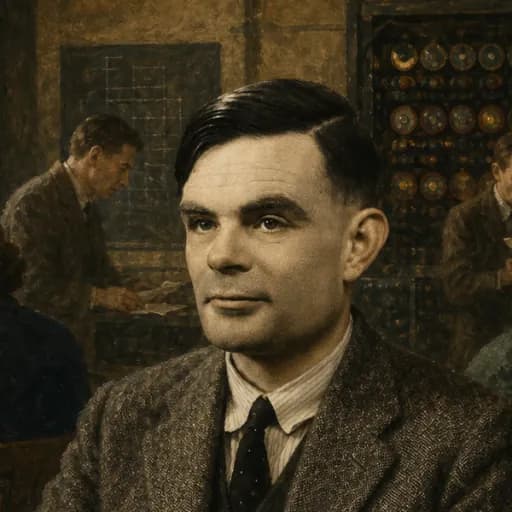
Models of computation meet stored-program design
Turing’s 1936 paper proposed a theoretical model for analysing universal computation. Mathematicians and engineers, including von Neumann, later developed stored-program designs through work such as the EDVAC discussions. The connection joins theory, circuitry, and memory rather than reducing the computer to one inventor and one document.
Evidence for this connection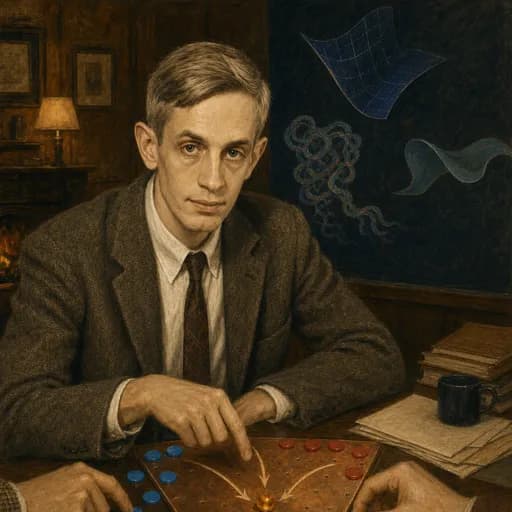
From zero-sum games to equilibrium for every player
After von Neumann and Morgenstern developed game theory around strategic and largely zero-sum settings, Nash generalized equilibrium to n-player games mixing competition and cooperation.
Evidence for this connectionCurated sources and problems. Bring one discovery back from OEIS, Project Euler, MathOverflow, or arXiv.