Central anchor5/8
Continuum Hypothesis
Through Continuum Hypothesis: How far can mathematics control its own infinities, paradoxes, and limits of proof?
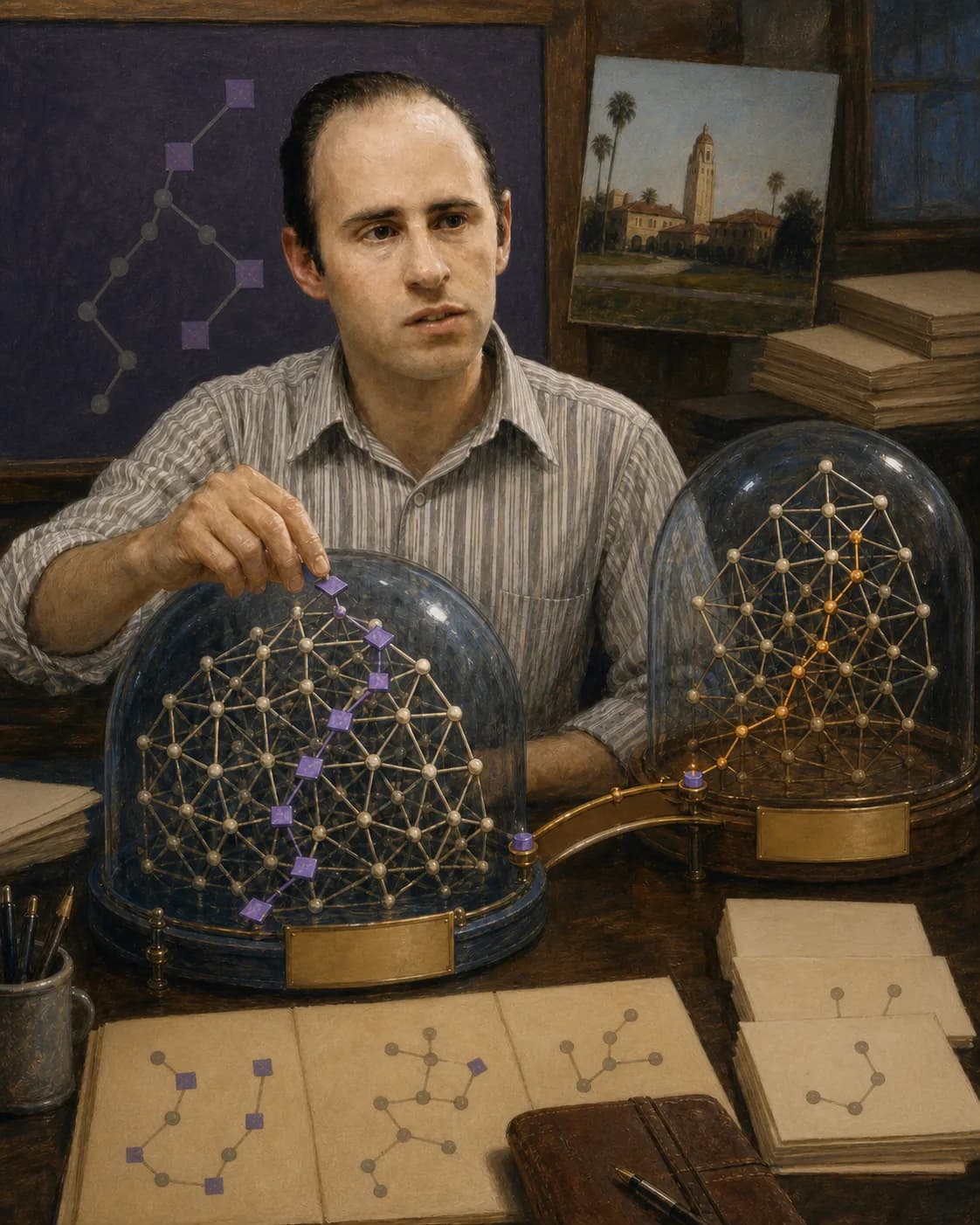
Constructing different models instead of choosing a proposition as simply true or false
The face uses a 1960s photograph. The two domes and condition path are an editorial metaphor for forcing in 1963, not real apparatus. Cohen did not settle CH as true or false; under stated consistency assumptions his direction complemented Gödel's 1940 result to establish independence from ZFC. Later developments by Solovay, Lévy, and others are not absorbed into one person.
MathVoyage editorial direction · OpenAI image generation · historical photograph identity reference · generated-text correction · 2026-08-07
Remember the mind, not only the dates
The idea to carry forward
Together, Gödel’s 1940 and Cohen’s 1963 results show that ZFC proves neither CH nor ¬CH.Enter through one scene
After turning intensively to set theory in 1962, Cohen invented forcing at Stanford in 1963. By constructing forcing extensions in which propositions such as ¬CH hold, the method complemented Gödel’s CH direction and became a central technique in set theory and model theory.
Questions this person helps open
These are reverse projections of existing editorial routes, not claims of direct influence or sole invention.
Through Continuum Hypothesis: How far can mathematics control its own infinities, paradoxes, and limits of proof?
If all mathematics is built from collections, what becomes possible—and what breaks?
Can one endless thing be larger than another?
PROFILE 02 · DEEP VOYAGE
Instead of memorizing more dates, follow the world that shaped this mind, the scenes that changed its direction, and the questions carried onward.
CHAPTER 01 · PERSON AND PERIOD
Before the finished achievement, read what this person treated as a problem and where the surviving evidence reaches its limit.
Born in 1934 in Long Branch, New Jersey, into a Polish-Jewish immigrant family, Cohen grew up in New York. He earned a PhD in analysis at the University of Chicago under Antoni Zygmund, then worked at MIT and the IAS before joining Stanford in 1961. After turning intensively to set theory in 1962, he invented forcing and established the relative consistency of adjoining ¬CH in 1963. Combined with Gödel’s 1940 CH direction, this established independence of the continuum hypothesis from ZFC. The forcing work earned Cohen a Fields Medal in 1966; he remained at Stanford and died in 2007.
CHAPTER 02 · TURNING SCENES
Follow the moments when the idea moved one step further. Every scene continues through an evidenced place or an honestly labelled time context.
Scene 1 / 3
After turning intensively to set theory in 1962, Cohen invented forcing at Stanford in 1963. By constructing forcing extensions in which propositions such as ¬CH hold, the method complemented Gödel’s CH direction and became a central technique in set theory and model theory.
Scene 2 / 3
In the two-part PNAS paper The Independence of the Continuum Hypothesis (1963–1964), Cohen used forcing to establish the relative-consistency direction for ¬CH. Combined with Gödel’s 1940 CH direction, this established independence from ZFC.
Scene 3 / 3
At the Moscow ICM he was recognized for using forcing to prove the set-theoretic independence of the axiom of choice and the generalized continuum hypothesis. Atiyah, Grothendieck, and Smale were the other 1966 medalists.
THOUGHT EXPERIMENT · NOT A FACT CLAIM
This is a thought experiment about influence, not a verified historical fact.
Without forcing, the construction of ¬CH models complementing Gödel’s CH direction—and thus the completed independence result—would likely have arrived later. From the 1960s onward Solovay, Lévy, and many other set theorists developed forcing for a wide range of model constructions and independence questions involving measurability, weakenings or failures of choice, and the Suslin hypothesis. Cohen’s move from analysis into set theory became a prominent example of crossing disciplinary boundaries.
STANDING ON SHOULDERS · EVIDENCED CONNECTIONS
We do not draw a line merely because two people shared an era. Only connections traced through works, problems, or teaching appear with an explanation and evidence.
Paul Cohen
Modern Era
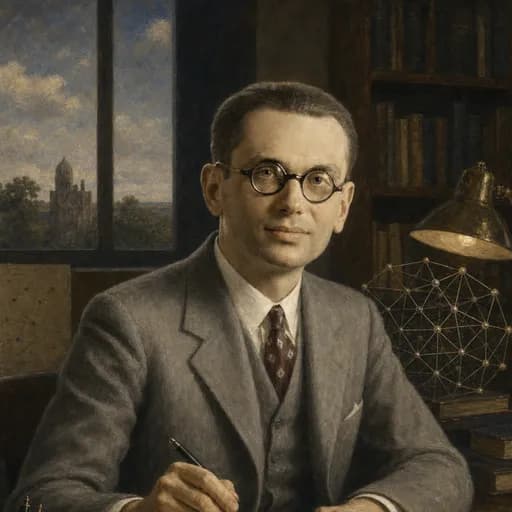
Completing both sides of continuum independence
After Gödel proved relative consistency of the continuum hypothesis, Cohen used forcing to prove relative consistency of its negation. Together the results established independence from ZFC.
Evidence for this connectionCurated sources and problems. Bring one discovery back from OEIS, Project Euler, MathOverflow, or arXiv.