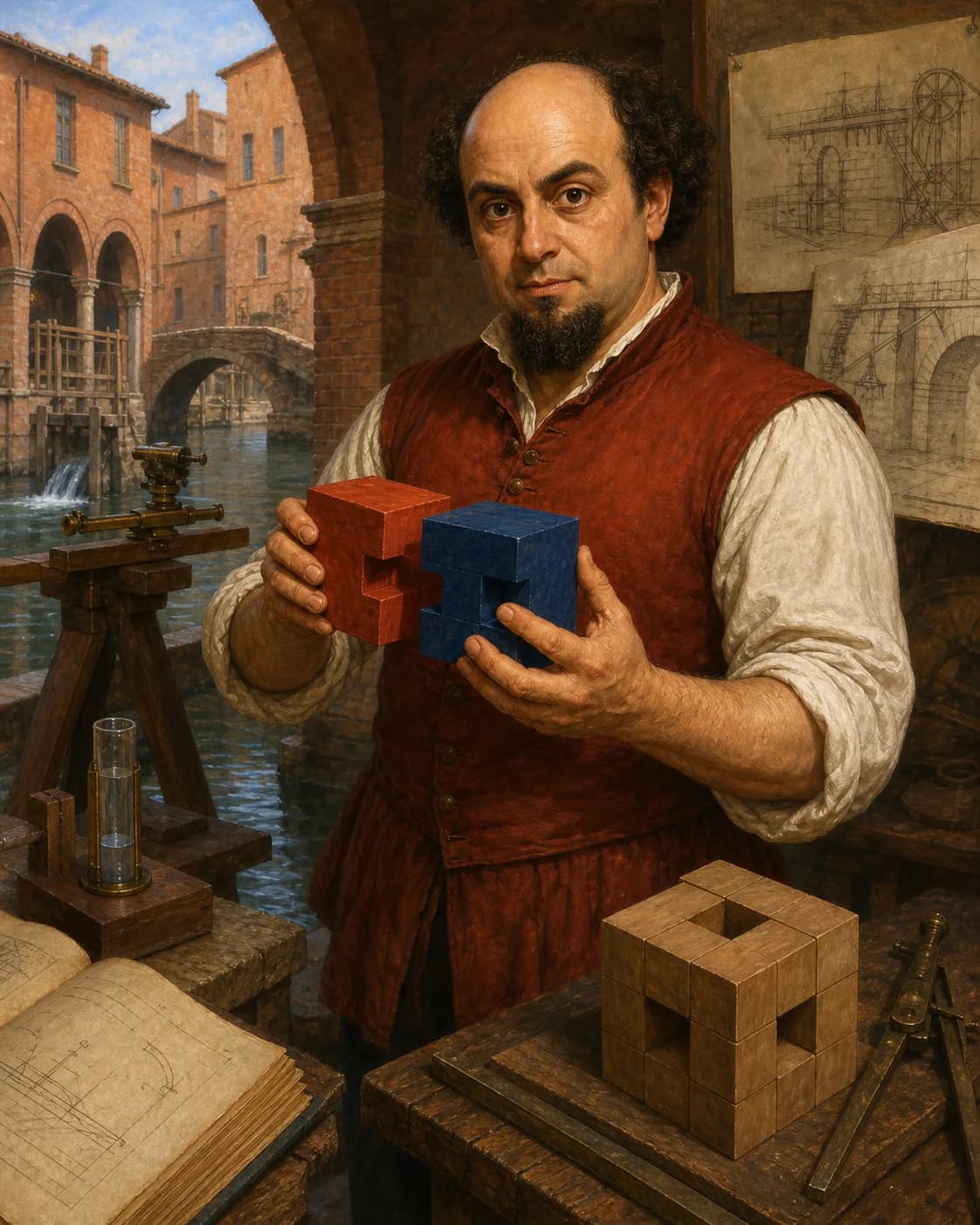
Rafael Bombelli
Life
A Bolognese engineer-mathematician. He took the imaginary numbers Cardano had handled reluctantly and made them into a working arithmetic. His 1572 L'Algebra gave the explicit rules for adding, multiplying, and dividing (a+bi) and (c+di).
Decisive moments
Studying Diophantus’s Arithmetica
After encountering a Greek manuscript in Rome, he translated portions and used them in his algebra. This was distinct from Bachet’s 1621 edition, in which Fermat later wrote his famous note.
L'Algebra published — arithmetic for imaginary expressions
BolognaThe first three books gave rules for adding and multiplying positive and negative square-root-of-minus-one expressions and used them in the irreducible case of a cubic.
If this person hadn't existed
This is a thought experiment about influence, not a verified historical fact.
Beginners expand (2+i)(2−i) and watch the imaginary terms cancel. Intermediate learners calculate with i² = −1. Advanced learners follow the casus irreducibilis, where a cubic with real roots passes through complex expressions. Experts connect the episode to algebraic closure and Galois theory.
Influence network
Beyond MathVoyage
Loading…