Gerolamo Cardano
LifeDeep Story
A Renaissance physician and mathematician whose 1545 Ars Magna published methods for cubic and quartic equations. The cubic story involved Tartaglia’s secrecy oath, del Ferro’s earlier work, and Ferrari’s collaboration, while calculations with square roots of negative numbers foreshadowed later complex arithmetic.
Decisive moments
Learning Tartaglia's method
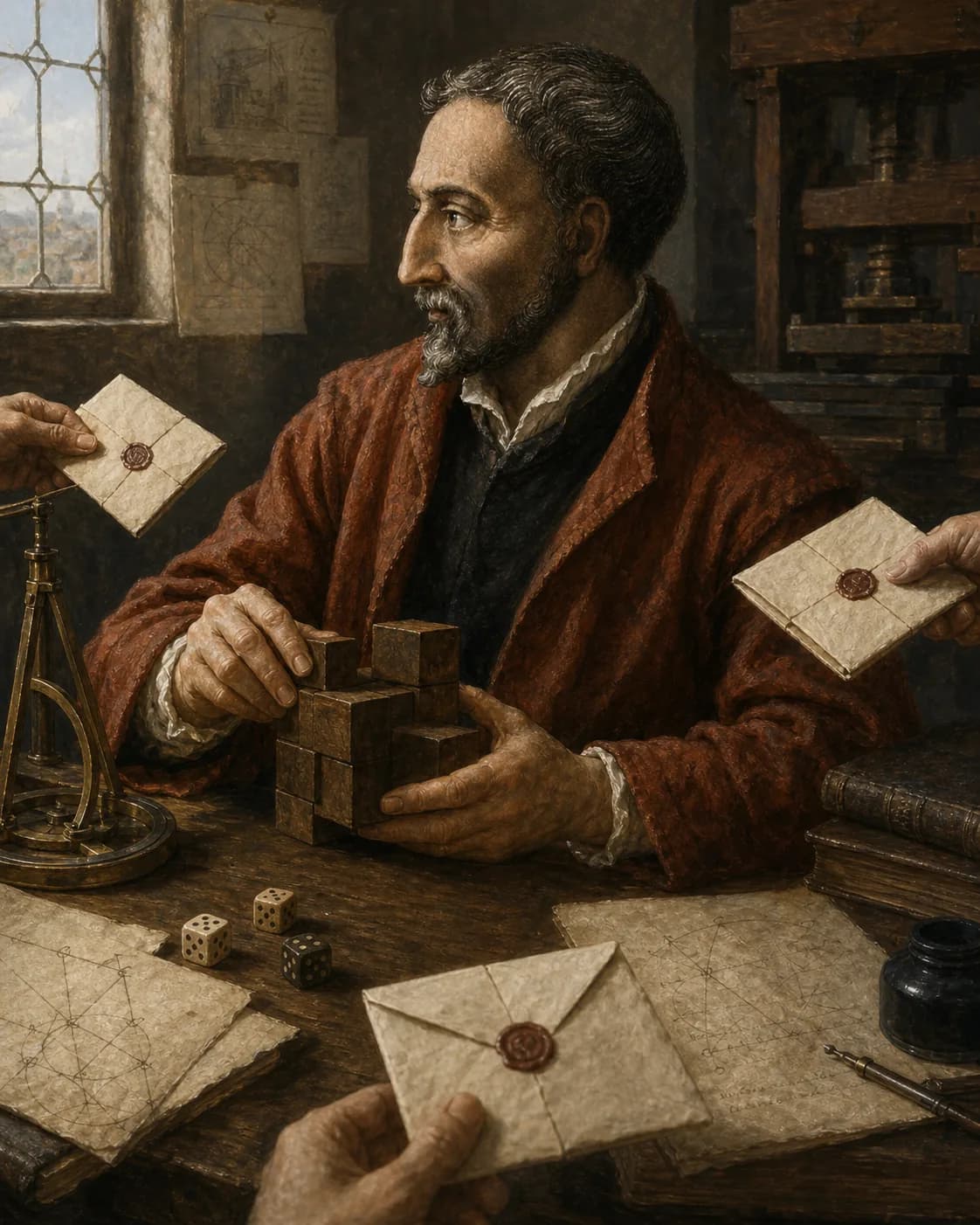
BolognaCardano swore not to publish and learned Tartaglia’s method for a class of cubics. He later judged the oath differently after seeing evidence of del Ferro’s earlier solution.
Ars Magna — methods and a priority dispute
He published methods for cubics and quartics while crediting del Ferro, Tartaglia, and Ferrari. Calculations involving √−15 exposed a problem for later complex arithmetic rather than completing the concept.
Imprisoned for casting horoscopes
Tried by the Inquisition for casting a horoscope of Jesus — a snapshot of a turbulent life that swung between gambling and medicine, mathematics and mysticism.
If this person hadn't existed
This is a thought experiment about influence, not a verified historical fact.
Cardano’s scene is not the lone invention of complex numbers but a moment when calculation outran accepted concepts. A real answer could require an intermediate √−15, setting up Bombelli’s later effort to make the arithmetic consistent.
Influence network
Beyond MathVoyage
Loading…