Central anchor6/13
Dimension
Through Dimension: What survives when shapes change, and which rules divide one world from another?
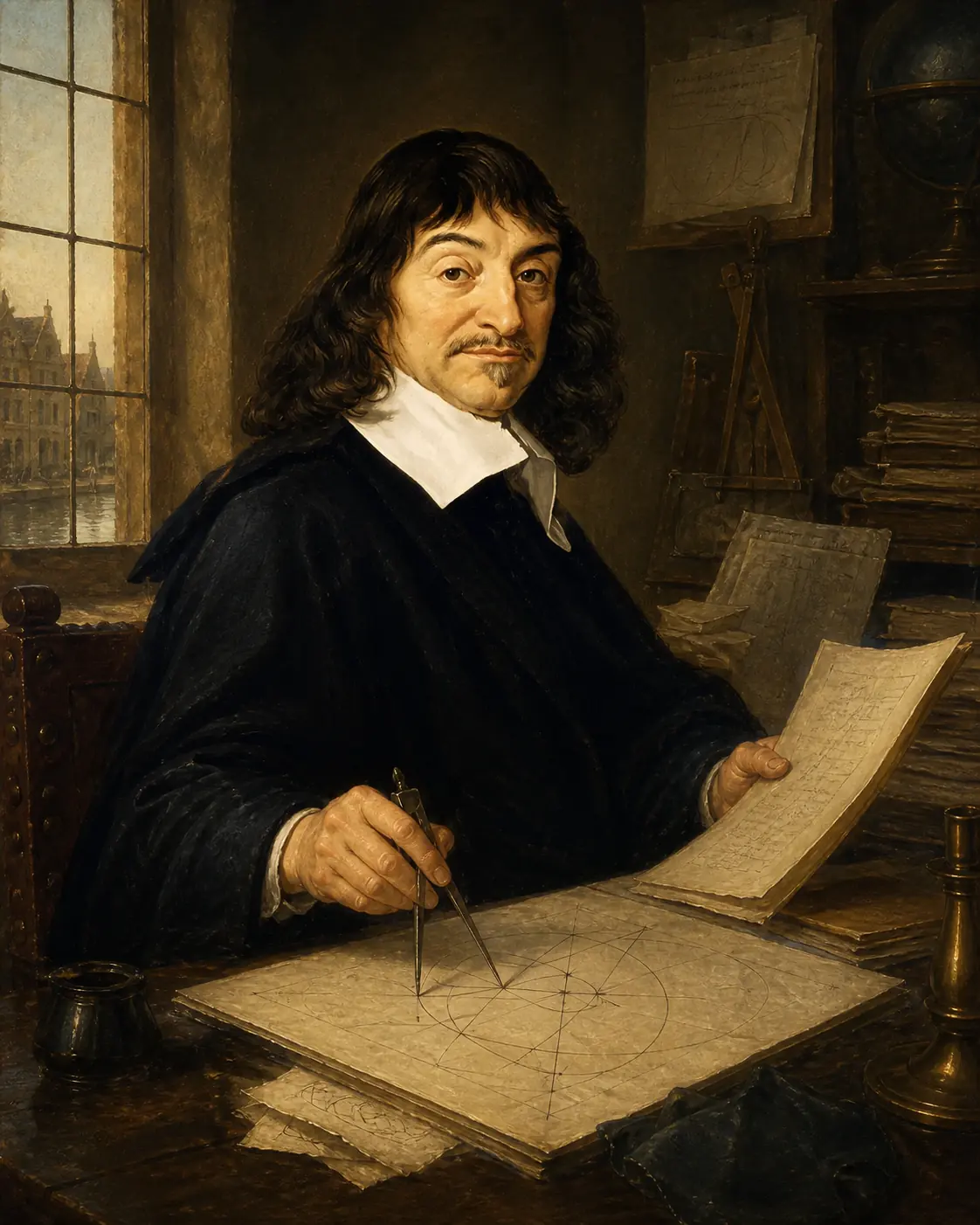
Making geometric curves available to algebraic calculation
The face draws on the familiar Descartes portrait tradition, but this Dutch room and drawing do not record one writing session. The 1637 Geometry joined algebra and geometry powerfully, yet Descartes did not instantly create the whole modern coordinate system alone; Fermat developed related methods independently.
MathVoyage editorial direction · OpenAI image generation · historical likeness reference · 2026-08-07
Remember the mind, not only the dates
The idea to carry forward
Cogito, ergo sum.Enter through one scene
Baillet's later biography reports that Descartes interpreted three dreams in November 1619 as signs of an intellectual vocation. Their meaning should not be treated as a finished research program.
Geometry and algebra long looked like different problem-solving languages. Translate a curve into an equation and an intersection becomes a shared solution, while a moving point’s path becomes a calculable relation.
Move the same object back and forth between two languages.
Choose a shape to reveal an algebraic expression and the new question it enables.
Questions this person helps open
These are reverse projections of existing editorial routes, not claims of direct influence or sole invention.
Through Dimension: What survives when shapes change, and which rules divide one world from another?
Why did one right-triangle equation crack the world of fractions?
PROFILE 02 · DEEP VOYAGE
Instead of memorizing more dates, follow the world that shaped this mind, the scenes that changed its direction, and the questions carried onward.
CHAPTER 01 · PERSON AND PERIOD
Before the finished achievement, read what this person treated as a problem and where the surviving evidence reaches its limit.
A philosopher and mathematician who developed a method of doubt and translated geometric problems into algebraic form. Analytic geometry also had independent contributors, especially Fermat. Paris was one stage rather than the whole career: most mature writing unfolded while he moved among addresses in the Dutch Netherlands from late 1628 until 1649, before his final move to Stockholm.
CHAPTER 02 · TURNING SCENES
Follow the moments when the idea moved one step further. Every scene continues through an evidenced place or an honestly labelled time context.
Scene 1 / 3
Baillet's later biography reports that Descartes interpreted three dreams in November 1619 as signs of an intellectual vocation. Their meaning should not be treated as a finished research program.
Scene 2 / 3
He linked curves with equations and used algebra to solve geometric problems. Modern coordinate notation and analytic geometry were refined by several later mathematicians.
Scene 3 / 3
He died after moving to Sweden at Queen Christina's invitation. The familiar chain from dawn lessons and cold weather to pneumonia is context, not a proven single cause.
CHAPTER 03 · IDEAS IN MOTION
A city is not scenery but a condition where people, texts, institutions, and tools could meet. Each pin marks an evidenced activity window, not an entire life.
AD 1625 - AD 1628
Mersenne network · before the Dutch move
AD 1629 - AD 1648
Dutch writing-period anchor · not continuous residence
AD 1637 - AD 1637
Publication of the Discourse and Geometry
AD 1649 - AD 1650
Final move · end of life
CHAPTER 04 · TOOLS LEFT BEHIND
The useful question is not a star rating, but what remained available for solving another problem.
Introduced coordinates to unite geometry and algebra.
THOUGHT EXPERIMENT · NOT A FACT CLAIM
This is a thought experiment about influence, not a verified historical fact.
The analytic geometry developed by Descartes and Fermat made it routine to move between curves and equations. It became a powerful language for calculus and mathematical physics without making all quantitative science the product of one book.
STANDING ON SHOULDERS · EVIDENCED CONNECTIONS
We do not draw a line merely because two people shared an era. Only connections traced through works, problems, or teaching appear with an explanation and evidence.
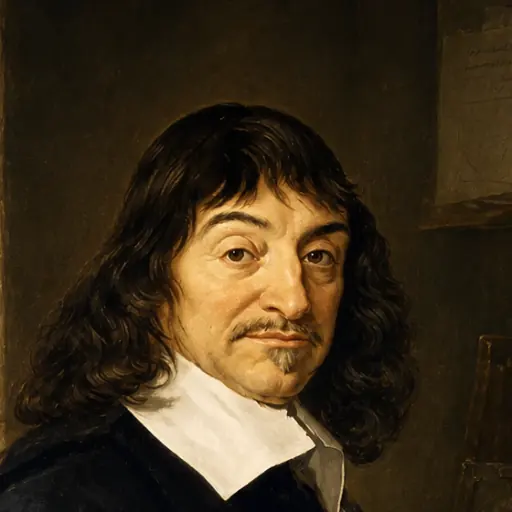
René Descartes
Renaissance
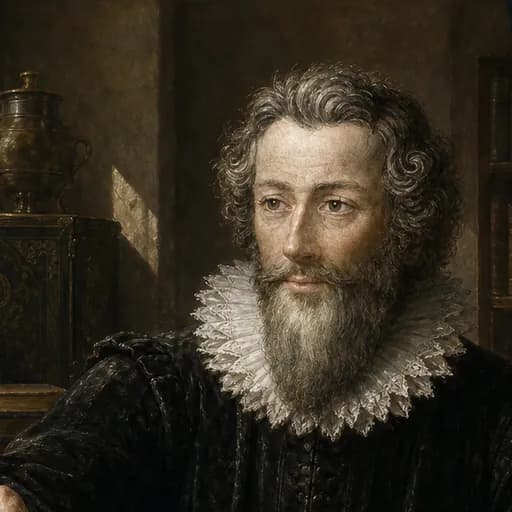
From symbolic algebra to coordinate geometry
Viète’s symbolic language for unknown and known quantities prepared the algebraic foundation on which Descartes translated curves into equations.
Evidence for this connection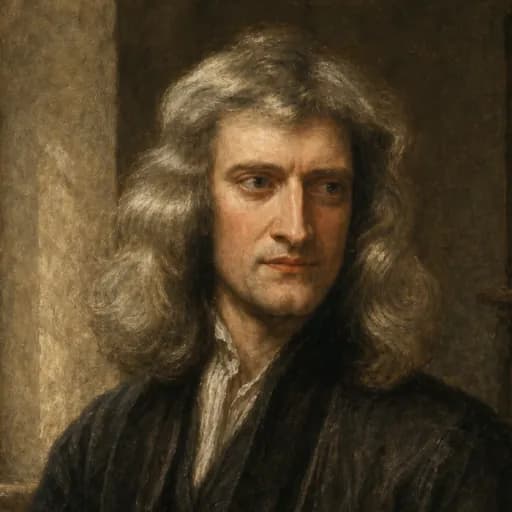
Coordinates and curves become the language of calculus
Newton studied Descartes’ philosophy and analytic geometry. Treating curves through algebraic expressions became essential language for his fluxions and infinite-series work.
Evidence for this connectionCurated sources and problems. Bring one discovery back from OEIS, Project Euler, MathOverflow, or arXiv.