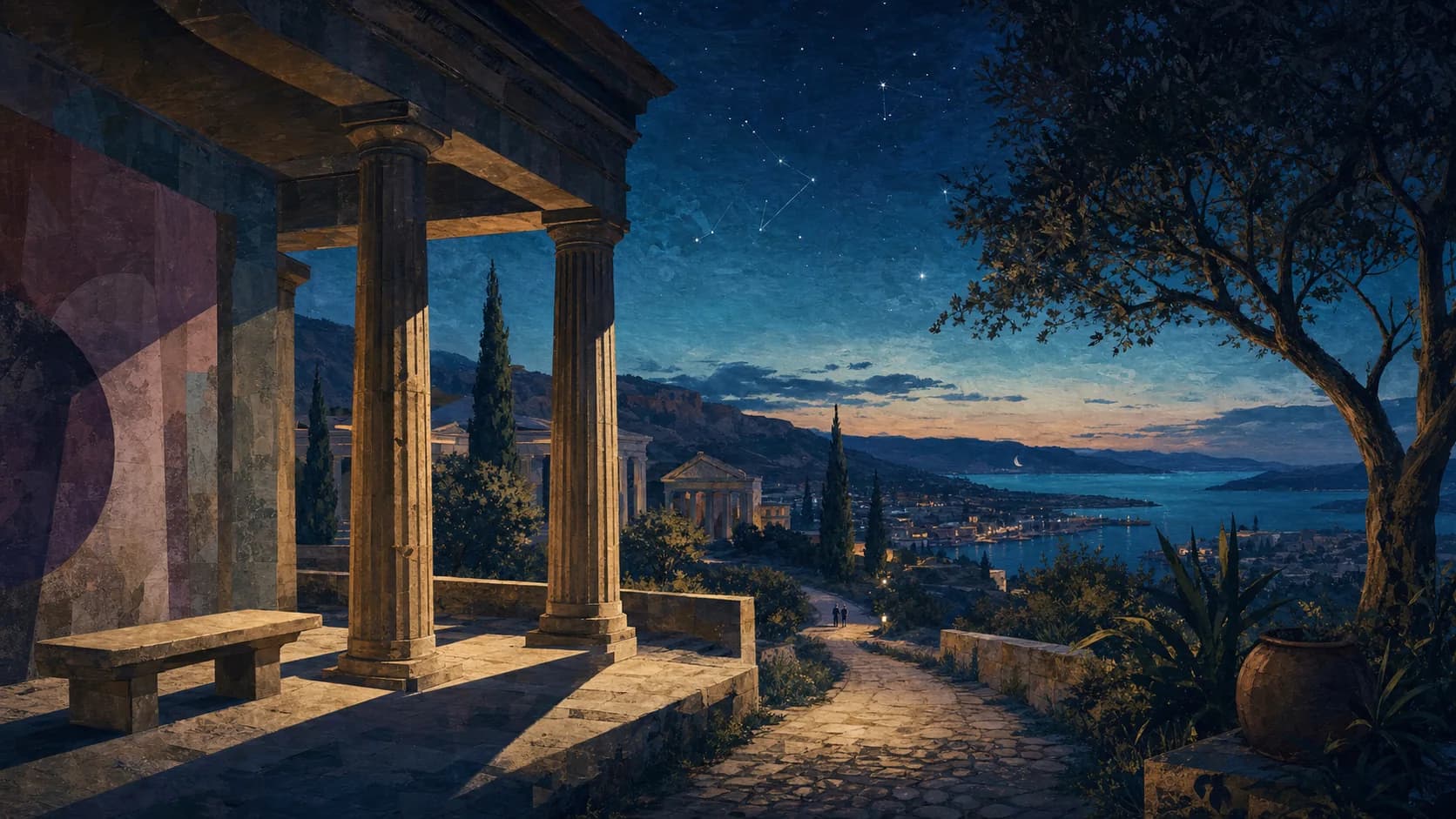
An editorial illustration imagining an ancient Mediterranean colonnade beneath a night sky
All philosophy questions

SCENES OF THOUGHT

Watch ideas move through time and place.

Fourteen questions become fourteen source-backed scenes across 10 places. Play the route, pause on a question, and enter the work behind it.

This is a curated camera route, not a claim of linear progress or direct influence. The moving line shows the viewer’s itinerary only.

Visual note: AI-assisted editorial illustration for imaginative orientation; not a historical photograph or documentary reconstruction.

ACT 1 OF 4

World and the stage of life

Ask what exists and which activities and relationships make a life go well.

01 / 14

지도를 불러오는 중…

Act 1 editorial illustration · not a historical record

Around 335 BCEAthensActivity

THE QUESTION IN THIS SCENE

What is real, and what remains through change?

Work associated with the Lyceum period systematizes a vocabulary of substance and change.

Aristotle — Matter and form, potentiality and actuality

Can the move from potentiality to actuality explain how something changes while remaining itself?

The camera opens in Athens.

Why this scene is pinned here

The source supports the event-place association, not the truth of the philosophy or a line of influence.

  • Aristotle

    Stanford Encyclopedia of Philosophy

    Locator: §1 Life, the Lyceum in Athens

    Open source
Think inside this question

Playback advances every 8 seconds. Your last scene stays on this device only.

All fourteen scenes

Every link restores the exact scene. The order is chronological; the acts are editorial chapters, not historical borders.

  1. 01 · 335 BCE · Athens

    What is real, and what remains through change?

  2. 02 · 306 BCE · Athens

    What makes a life go well?

  3. 03 · 1641 CE · Paris

    What can we claim to know?

  4. 04 · 1641 CE · Paris

    What makes a mind and a self persist?

  5. 05 · 1677 CE · Amsterdam

    Can we be responsible if we could not have done otherwise?

  6. 06 · 1748 CE · London

    How far can the past support the future?

  7. 07 · 1843 CE · Copenhagen

    How far can reason speak about faith?

  8. 08 · 1892 CE · Jena

    How do words point to the world?

  9. 09 · 1934 CE · New York

    Why does art matter, and what makes a work valuable?

  10. 10 · 1942 CE · Paris

    How should we face suffering and death?

  11. 11 · 1949 CE · Paris

    Whose knowledge is allowed to count?

  12. 12 · 1962 CE · Chicago

    What makes an inquiry scientific?

  13. 13 · 1971 CE · Cambridge, MA

    What makes power legitimate and rules fair?

  14. 14 · 1984 CE · Oxford

    What do we owe future people and the more-than-human world?