Central anchor1/8
Group Theory
How can we calculate what remains while a shape changes?
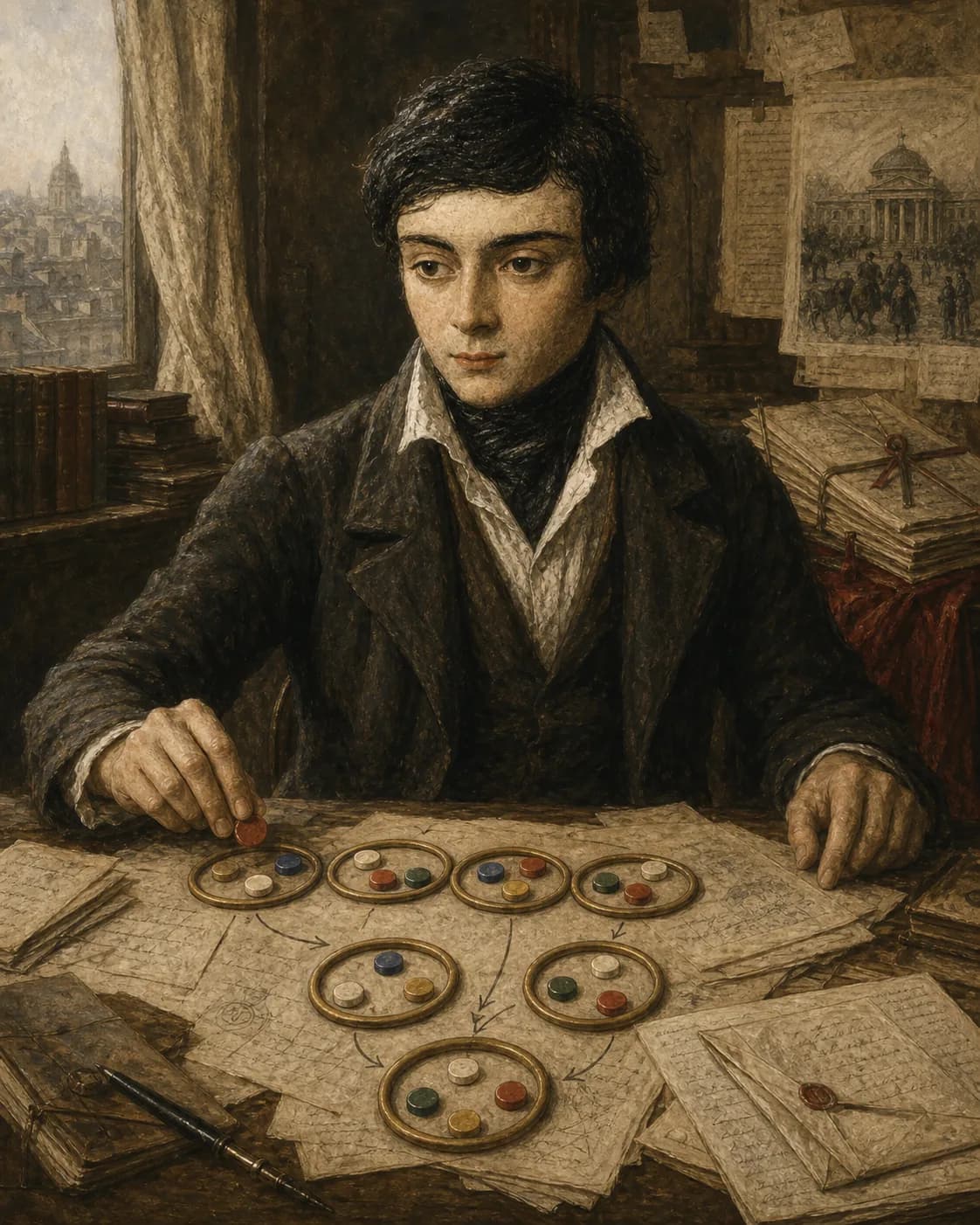
Asking what symmetry permits before calculating roots
The face uses the limited drawing tradition attributed to his brother Alfred; it is not a photograph. The scene compresses the 1830-1832 manuscripts and Chevalier letter while rejecting the myth that all group theory was created in a single night before the duel.
MathVoyage editorial direction · OpenAI image generation · family-attributed drawing identity reference · 2026-08-07
Remember the mind, not only the dates
The idea to carry forward
Solvability by radicals can be read from the symmetry structure of the roots.Enter through one scene
After failing the entrance examination a second time, he entered the École Préparatoire. The story that he threw a board eraser at an examiner is an unverified later anecdote.
Questions this person helps open
These are reverse projections of existing editorial routes, not claims of direct influence or sole invention.
How can we calculate what remains while a shape changes?
Through Galois Theory: How can we recognize the same structure inside different problems?
PROFILE 02 · DEEP VOYAGE
Instead of memorizing more dates, follow the world that shaped this mind, the scenes that changed its direction, and the questions carried onward.
CHAPTER 01 · PERSON AND PERIOD
Before the finished achievement, read what this person treated as a problem and where the surviving evidence reaches its limit.
A mathematician who connected solvability by radicals with the symmetries of polynomial roots. By age 20, Galois had developed a group-based way to study relations preserved when roots are permuted. His approximately seven-page testamentary letter to Auguste Chevalier, written before his fatal duel in 1832, summarized existing results and requested that his manuscripts be reviewed; it was not the night on which he created the whole theory from scratch. He died from his wound the next day. Chevalier and Galois’s brother preserved the papers, and Liouville announced their importance in 1843 before publishing major manuscripts in 1846. This work became the starting point of what is now called Galois theory.
CHAPTER 02 · TURNING SCENES
Follow the moments when the idea moved one step further. Every scene continues through an evidenced place or an honestly labelled time context.
Scene 1 / 3
After failing the entrance examination a second time, he entered the École Préparatoire. The story that he threw a board eraser at an examiner is an unverified later anecdote.
Scene 2 / 3
He was arrested twice for republican political activity and spent several months imprisoned after the second case. Amid that turmoil he continued revising his mathematical manuscripts.
Scene 3 / 3
Before the duel, he sent Chevalier an approximately seven-page letter summarizing existing research and asking that the remaining manuscripts be reviewed by mathematicians. He died from the wound the next day at age 20.
THOUGHT EXPERIMENT · NOT A FACT CLAIM
This is a thought experiment about influence, not a verified historical fact.
Even without Galois, other mathematicians would likely have developed links between equations and symmetry. The route and timing by which group structure became the standard language for solvability by radicals, however, might have been different.
STANDING ON SHOULDERS · EVIDENCED CONNECTIONS
We do not draw a line merely because two people shared an era. Only connections traced through works, problems, or teaching appear with an explanation and evidence.
Évariste Galois
Nineteenth-Century Mathematics
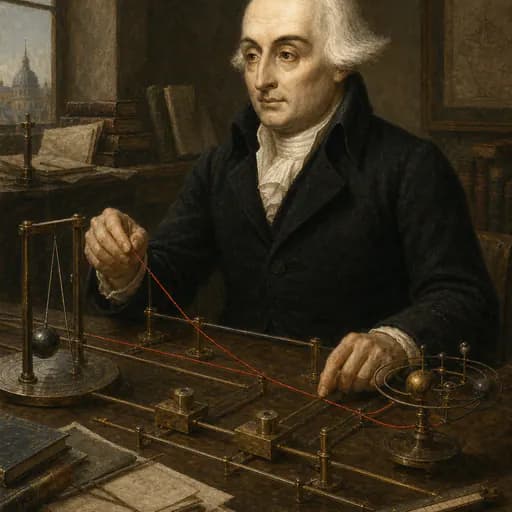
Looking at permutations rather than formulas
Lagrange exposed the central role of permutations of roots in equations. Galois pushed that viewpoint into a structural criterion for solvability by radicals.
Evidence for this connection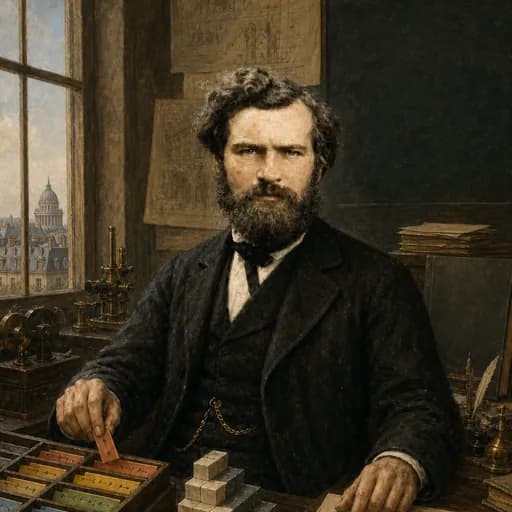
Turning posthumous ideas into modern group theory
Jordan organized post-Galois work on permutation groups and equations in his large 1870 treatise, greatly helping groups circulate as independent objects of study.
Evidence for this connectionCurated sources and problems. Bring one discovery back from OEIS, Project Euler, MathOverflow, or arXiv.