Central anchor3/8
Russell's Paradox
Through Russell's Paradox: How far can mathematics control its own infinities, paradoxes, and limits of proof?
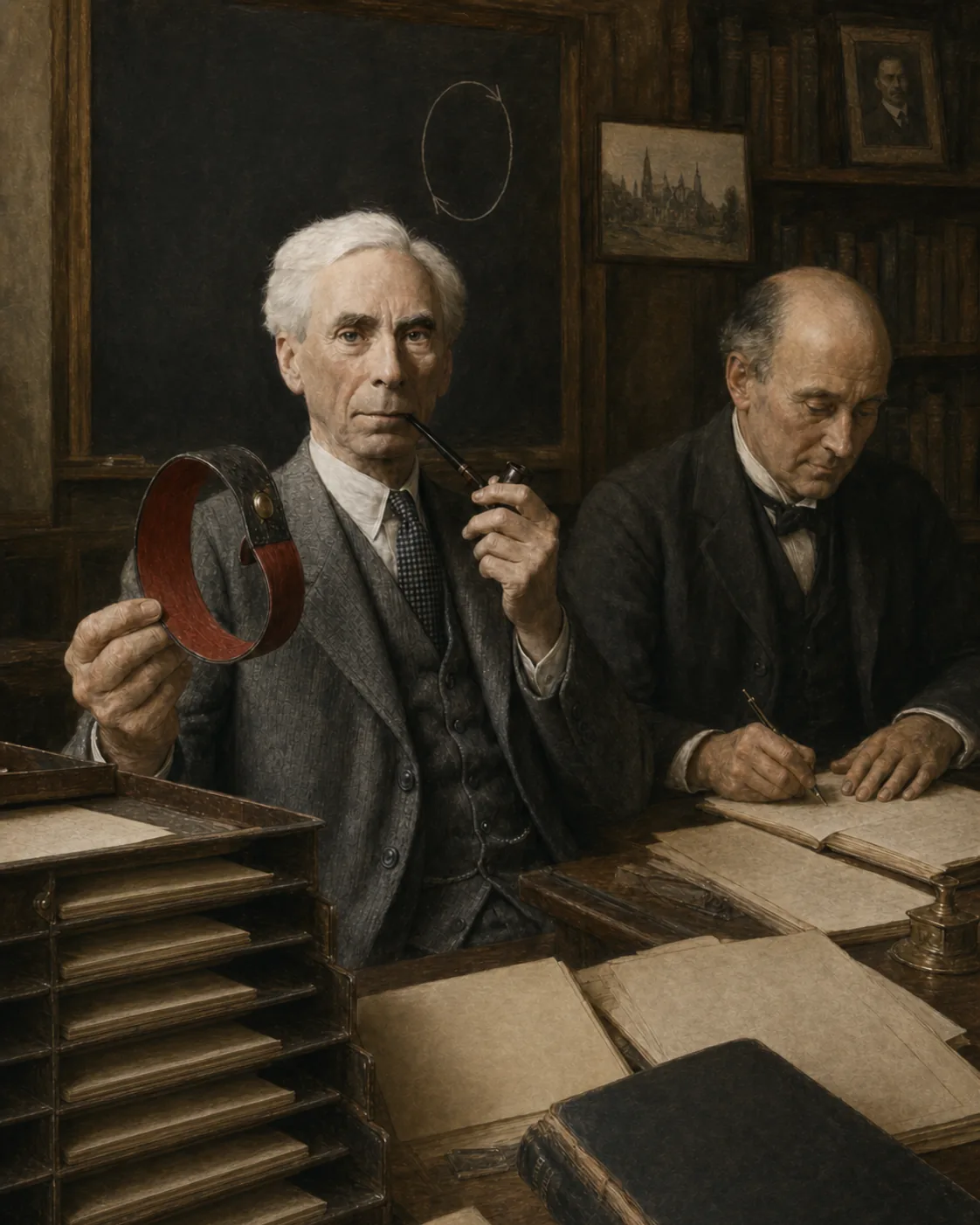
A self-referential rule forces a new grammar for sets
The face uses a surviving photograph. The scene compresses the 1901 paradox, 1902 Frege letter, and three-volume collaboration with Whitehead without invalidating all set theory or turning Principia into Russell's lone work or a fixed-page-number anecdote.
MathVoyage editorial direction · OpenAI image generation · historical photograph identity reference · precise generated-text removal edit · 2026-08-07
Remember the mind, not only the dates
Enter through one scene
In 1901 Russell discovered that the set R of all sets that do not contain themselves yields a contradiction. His later recollections vary between May, June, and spring, so the event is dated only to the year and no age is attached.
Questions this person helps open
These are reverse projections of existing editorial routes, not claims of direct influence or sole invention.
Through Russell's Paradox: How far can mathematics control its own infinities, paradoxes, and limits of proof?
If all mathematics is built from collections, what becomes possible—and what breaks?
PROFILE 02 · DEEP VOYAGE
Instead of memorizing more dates, follow the world that shaped this mind, the scenes that changed its direction, and the questions carried onward.
CHAPTER 01 · PERSON AND PERIOD
Before the finished achievement, read what this person treated as a problem and where the surviving evidence reaches its limit.
"Mathematics may be defined as the subject in which we never know what we are talking about, nor whether what we are saying is true." — Russell discovered his paradox at Cambridge in 1901 and explained it to Frege in a letter dated 16 June 1902. The brief formal statement — R contains R iff R does not contain R — exposed an inconsistency in Frege's system. With Alfred North Whitehead he later wrote the three volumes of Principia Mathematica (1910–1913), attempting to derive mathematics from logic. Volume I famously reaches the result corresponding to 1+1=2 only late in the book, but this account does not attach it to a page without naming an edition. A philosopher, anti-war activist, and 1950 Nobel laureate in Literature, Russell died on 2 February 1970 aged 97.
CHAPTER 02 · TURNING SCENES
Follow the moments when the idea moved one step further. Every scene continues through an evidenced place or an honestly labelled time context.
Scene 1 / 4
In 1901 Russell discovered that the set R of all sets that do not contain themselves yields a contradiction. His later recollections vary between May, June, and spring, so the event is dated only to the year and no age is attached.
Scene 2 / 4
While Grundgesetze II was in press, Russell wrote to the 53-year-old Frege explaining the briefly stated paradox he had discovered in 1901. Frege publicly acknowledged the problem in an appendix, and Russell later pursued type theory as a way around the paradoxes.
Scene 3 / 4
Co-authored with Whitehead and published by Cambridge University Press in 1910–1913. It used type theory in an attempt to derive mathematics from logic. Volume I famously reaches the result corresponding to 1+1=2 only late in the book, and Gödel's 1931 paper explicitly treated this system.
Scene 4 / 4
Awarded the 1950 Nobel Prize in Literature as a champion of humanitarian ideals and freedom of thought. From The Principles of Mathematics (1903) to A History of Western Philosophy (1945), Why I Am Not a Christian (1927), and anti-war essays — a 70-year writing career. A rare trajectory: from mathematician to most influential public intellectual of the 20th century.
THOUGHT EXPERIMENT · NOT A FACT CLAIM
This is a thought experiment about influence, not a verified historical fact.
Russell's paradox made the problem with unrestricted set formation and Frege's Basic Law V vivid, prompting responses including type theory and axiomatic set theory. Written with Whitehead, Principia Mathematica became a major logicist attempt to develop mathematics in formal logic and an important example for Gödel's 1931 analysis of formal systems. Russell also sustained a long public life in philosophy, anti-war activism, and peace advocacy.
STANDING ON SHOULDERS · EVIDENCED CONNECTIONS
We do not draw a line merely because two people shared an era. Only connections traced through works, problems, or teaching appear with an explanation and evidence.
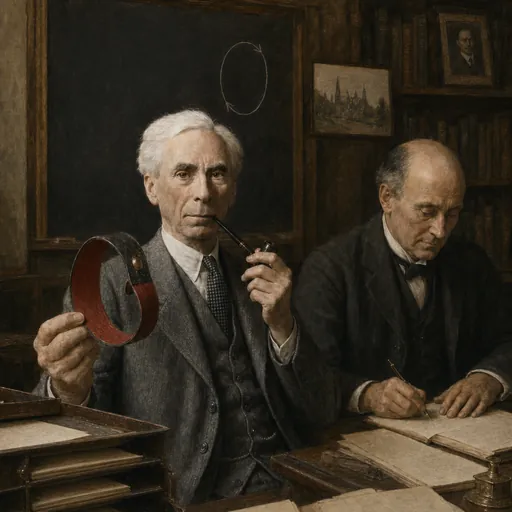
Bertrand Russell
Nineteenth-Century Mathematics
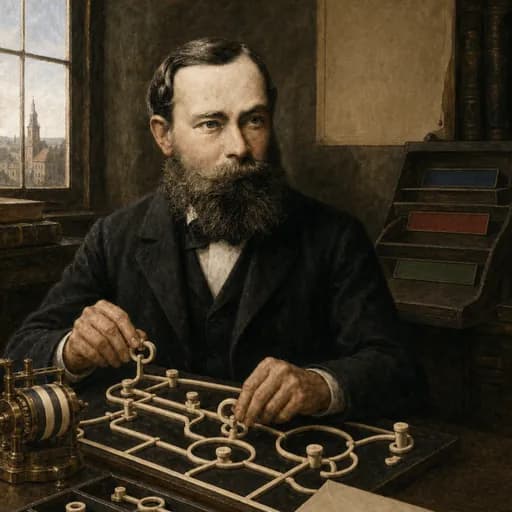
Inheriting logicism—and finding its contradiction
Russell embraced Frege’s logicist program but informed him in a 1902 letter of the paradox inside the system—an edge of inheritance and refutation at once.
Evidence for this connection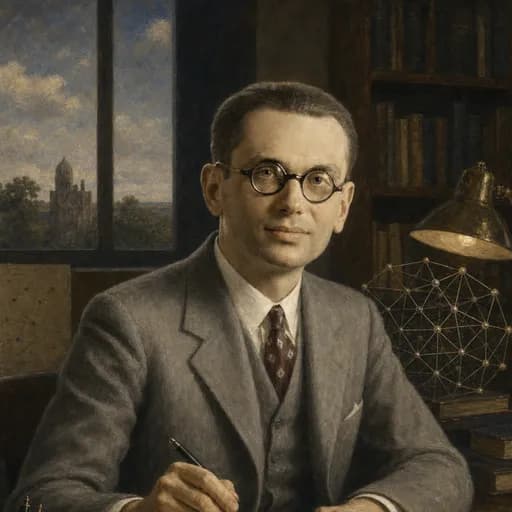
Testing Principia’s system from within
Gödel’s incompleteness theorems showed that consistent, effectively axiomatized systems strong enough for arithmetic—including systems in the Principia tradition—cannot decide every sentence expressible within them.
Evidence for this connectionCurated sources and problems. Bring one discovery back from OEIS, Project Euler, MathOverflow, or arXiv.