Central anchor6/16
Prime Numbers
As numbers grow, do primes fade away—or reveal a hidden order?
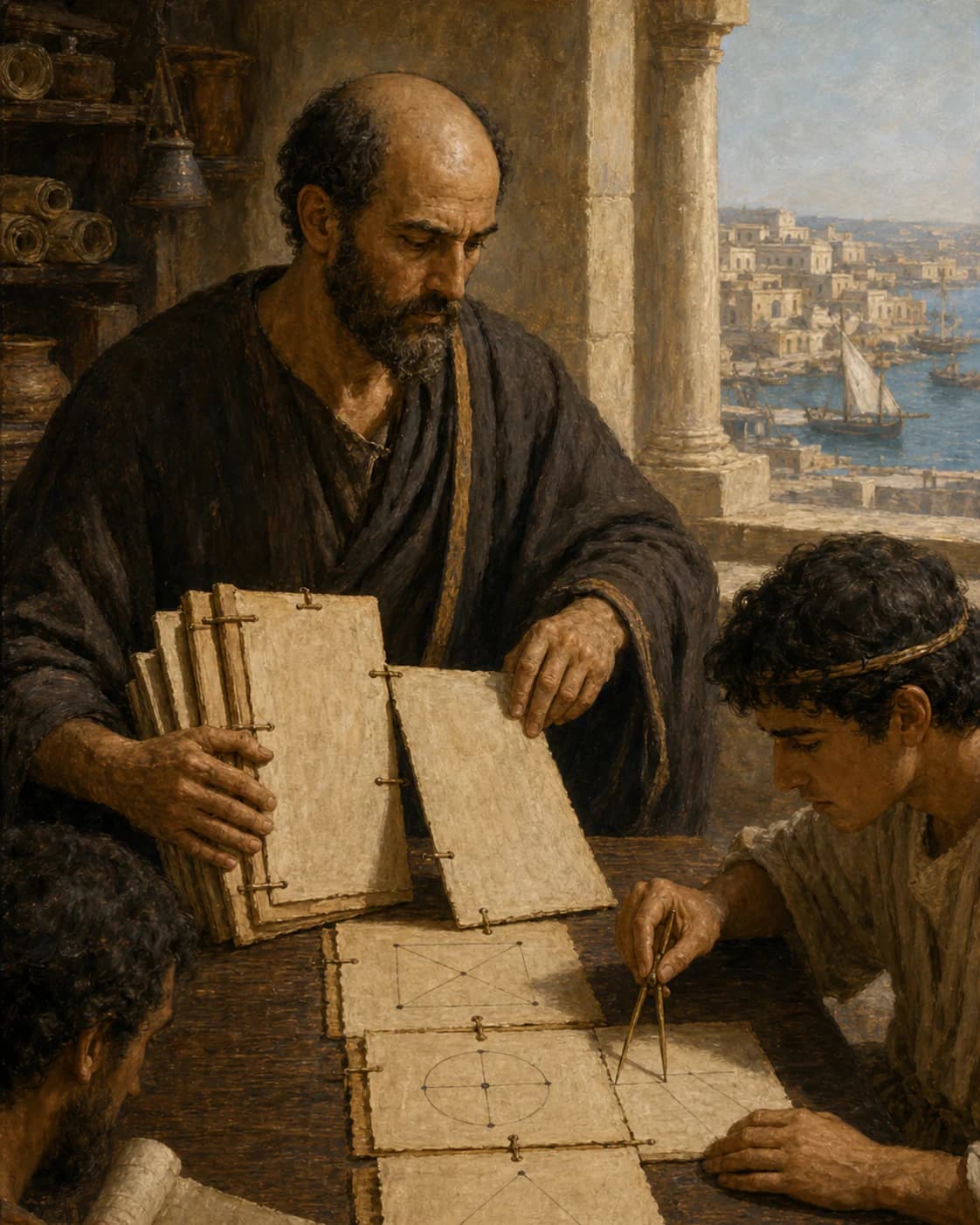
Editing a path that proofs could follow
Little is known of Euclid's life, and no verified lifetime portrait survives. The bald crown, short beard, dark mantle, and folio use Ribera's seventeenth-century Euclid only as a later identifying convention. The face, workplace, and collaboration are modern interpretations; the Elements organizes earlier mathematics and comes through a long editorial transmission rather than recording Euclid as first inventor of every proposition and proof.
MathVoyage editorial direction · OpenAI image generation · Jusepe de Ribera later iconography reference · no verified lifetime likeness · 2026-08-07
Remember the mind, not only the dates
The idea to carry forward
There is no royal road to geometry.Enter through one scene
Definitions and postulates lead into ordered proofs in geometry and number theory. It is one of the most influential surviving ancient syntheses of deductive mathematics.
The fifth postulate of the Elements looked longer and less self-evident than the others. After centuries of attempts to derive it, mathematicians reversed the question: instead of eliminating it, what geometries appear when it changes?
Which move at the parallel postulate creates the largest turn?
Compare three moves and see how the same starting point becomes different research.
Questions this person helps open
These are reverse projections of existing editorial routes, not claims of direct influence or sole invention.
As numbers grow, do primes fade away—or reveal a hidden order?
Through Golden Ratio: How can we find hidden order without counting everything?
Why did one right-triangle equation crack the world of fractions?
If one rule about parallel lines changes, does the shape of the universe change too?
PROFILE 02 · DEEP VOYAGE
Instead of memorizing more dates, follow the world that shaped this mind, the scenes that changed its direction, and the questions carried onward.
CHAPTER 01 · PERSON AND PERIOD
Before the finished achievement, read what this person treated as a problem and where the surviving evidence reaches its limit.
Author of The Elements. He established the foundations of mathematics through an axiomatic system that defined rigor for 2,300 years.
CHAPTER 02 · TURNING SCENES
Follow the moments when the idea moved one step further. Every scene continues through an evidenced place or an honestly labelled time context.
Scene 1 / 2
Definitions and postulates lead into ordered proofs in geometry and number theory. It is one of the most influential surviving ancient syntheses of deductive mathematics.
Scene 2 / 2
Unwieldy and not self-evident, the fifth postulate became, 2,000 years later, the launchpad of non-Euclidean geometry.
CHAPTER 03 · IDEAS IN MOTION
A city is not scenery but a condition where people, texts, institutions, and tools could meet. Each pin marks an evidenced activity window, not an entire life.
Wrote the Elements
CHAPTER 04 · TOOLS LEFT BEHIND
The useful question is not a star rating, but what remained available for solving another problem.
A thirteen-book foundation of mathematics and a model of the axiomatic method.
THOUGHT EXPERIMENT · NOT A FACT CLAIM
This is a thought experiment about influence, not a verified historical fact.
Greek proof traditions could have survived through other texts, but the Elements gave translators and teachers a shared ordered structure. Readers across centuries could criticize and extend the same chain of arguments.
STANDING ON SHOULDERS · EVIDENCED CONNECTIONS
We do not draw a line merely because two people shared an era. Only connections traced through works, problems, or teaching appear with an explanation and evidence.
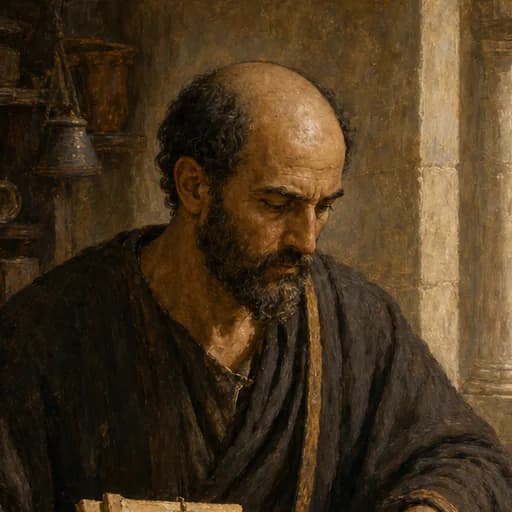
Euclid
Greek Period
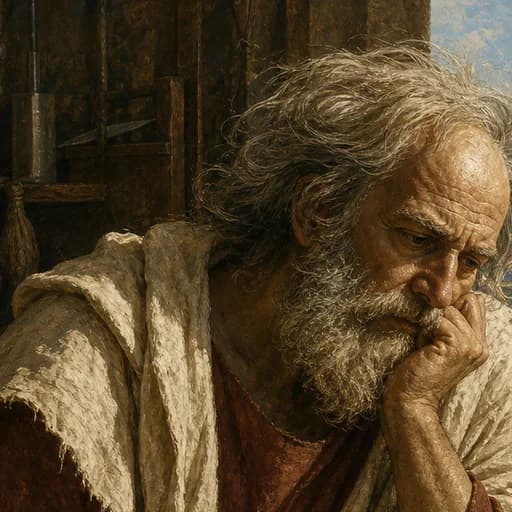
From axiomatic geometry to exhaustion
Archimedes worked within Euclid’s deductive framework and combined exhaustion with mechanical arguments to calculate areas and volumes, a decisive geometric ancestor of integration.
Evidence for this connection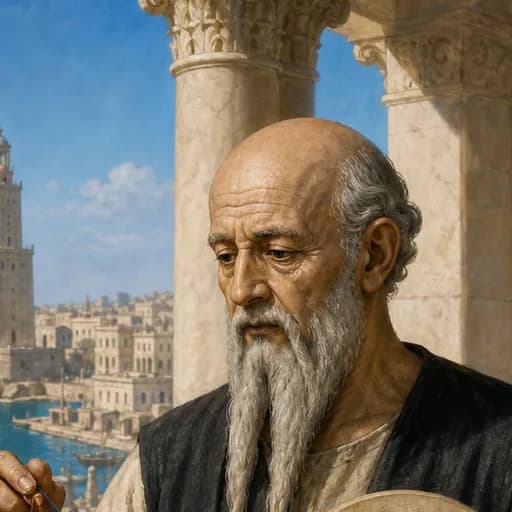
Conics after the Elements
Apollonius carried Euclid’s axiomatic language into a unified theory of the ellipse, parabola, and hyperbola in the Conics.
Evidence for this connectionCurated sources and problems. Bring one discovery back from OEIS, Project Euler, MathOverflow, or arXiv.