Central anchor11/13
Graph Theory
What can we learn after erasing distance and shape, leaving only connections?
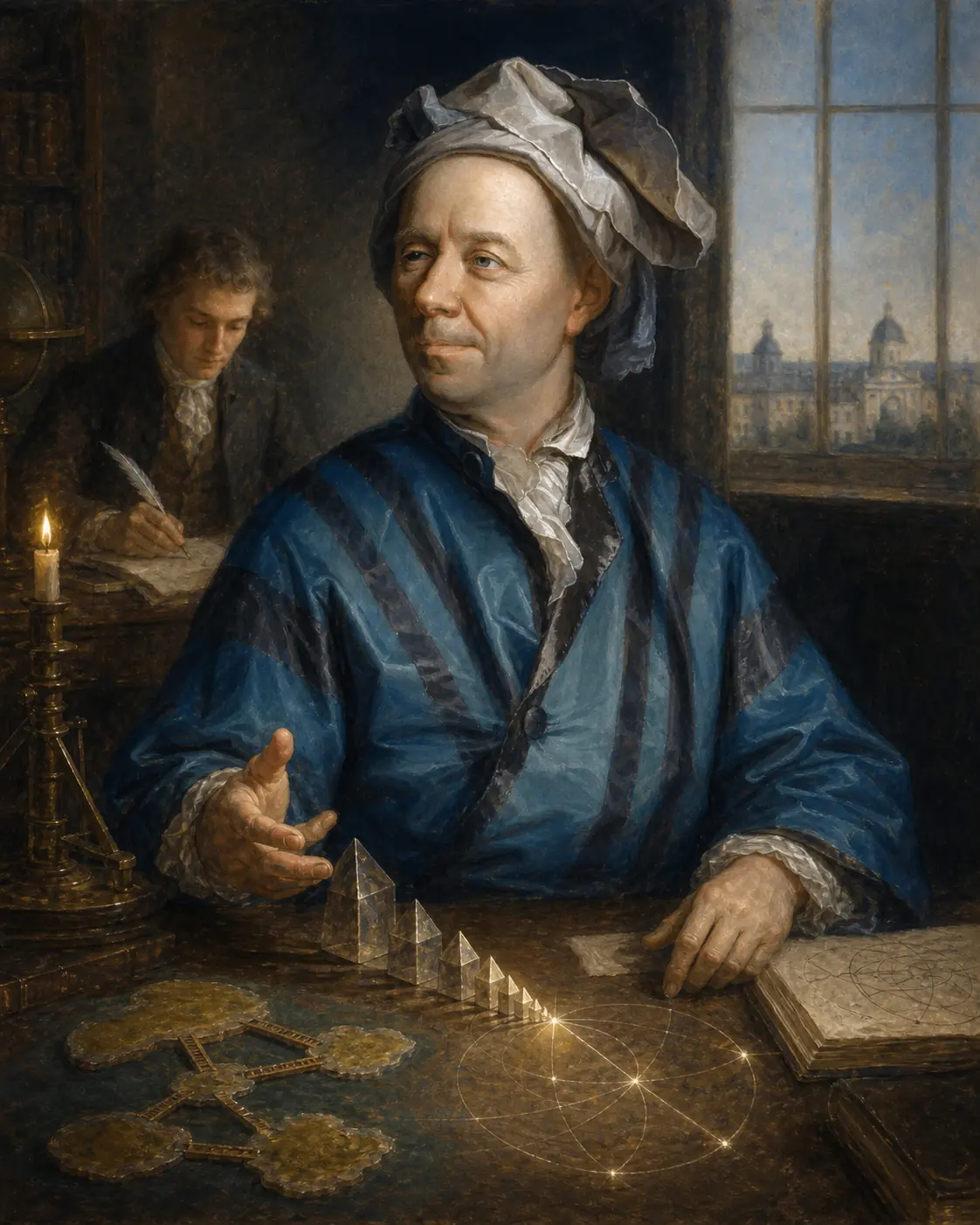
Continuing mathematics through memory, speech, and collaboration after losing sight
The face draws on the familiar Euler portrait tradition, but this St Petersburg dictation is not a record of one day. His work spans decades across Basel, St Petersburg, and Berlin, and sons, assistants, and scribes helped sustain calculation and writing after his loss of sight; the scene avoids a myth of isolated supernatural genius.
MathVoyage editorial direction · OpenAI image generation · historical likeness reference · 2026-08-07
Remember the mind, not only the dates
The idea to carry forward
Read Euler, read Euler, he is the master of us all.Enter through one scene
He obtained 1 + 1/4 + 1/9 + … = π²/6. Later standards sharpened parts of the argument, but the result and methods were transformative.
In the Königsberg walking puzzle, bridge lengths, angles, and scenery were distractions. Keep only how many bridges meet each land region and impossibility appears without trying every route.
Select each region and inspect whether its bridge count is odd or even.
A trail using every edge exactly once can have only zero or two odd-degree vertices.
Questions this person helps open
These are reverse projections of existing editorial routes, not claims of direct influence or sole invention.
What can we learn after erasing distance and shape, leaving only connections?
Through Function: How can instantaneous change and long accumulation become one language?
Through Infinite Series: How can instantaneous change and long accumulation become one language?
Through Catalan Numbers: How can we find hidden order without counting everything?
Through Generating Functions: How can we find hidden order without counting everything?
Through Goldbach Conjecture: How can we find hidden order without counting everything?
Why do stricter rules emerge after imaginary numbers are allowed?
Can we count exploding possibilities without listing every one?
PROFILE 02 · DEEP VOYAGE
Instead of memorizing more dates, follow the world that shaped this mind, the scenes that changed its direction, and the questions carried onward.
CHAPTER 01 · PERSON AND PERIOD
Before the finished achievement, read what this person treated as a problem and where the surviving evidence reaches its limit.
An exceptionally prolific author across analysis, number theory, mechanics, astronomy, and early graph problems. He introduced or popularized major notation and continued working by dictation with family and assistants after losing most of his sight.
CHAPTER 02 · TURNING SCENES
Follow the moments when the idea moved one step further. Every scene continues through an evidenced place or an honestly labelled time context.
Scene 1 / 3
He obtained 1 + 1/4 + 1/9 + … = π²/6. Later standards sharpened parts of the argument, but the result and methods were transformative.
Scene 2 / 3
The Introductio systematically developed relations between complex exponentials and trigonometry; e^(iπ)+1=0 is one special case.
Scene 3 / 3
After losing nearly all sight, he used memory and dictation and continued research with help from family, assistants, and scribes.
CHAPTER 03 · IDEAS IN MOTION
A city is not scenery but a condition where people, texts, institutions, and tools could meet. Each pin marks an evidenced activity window, not an entire life.
AD 1707 - AD 1727
Early education
CHAPTER 04 · TOOLS LEFT BEHIND
The useful question is not a star rating, but what remained available for solving another problem.
e^(iπ) + 1 = 0, often called the most beautiful formula in mathematics.
THOUGHT EXPERIMENT · NOT A FACT CLAIM
This is a thought experiment about influence, not a verified historical fact.
Euler did not single-handedly create eighteenth-century mathematics. Working through the Bernoulli network, academies, family, and assistants, he made notation and methods reusable across fields and greatly lowered the cost of connecting ideas.
STANDING ON SHOULDERS · EVIDENCED CONNECTIONS
We do not draw a line merely because two people shared an era. Only connections traced through works, problems, or teaching appear with an explanation and evidence.
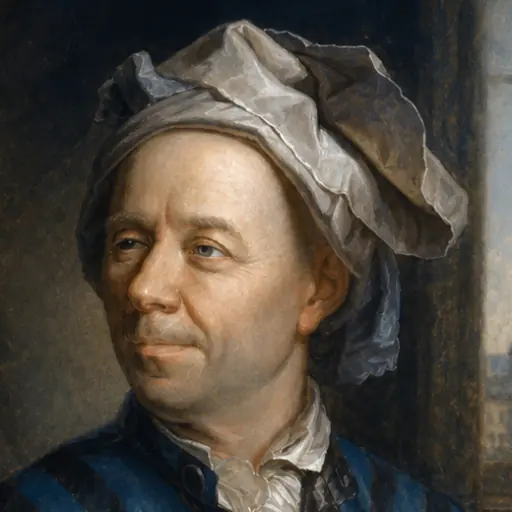
Leonhard Euler
Enlightenment
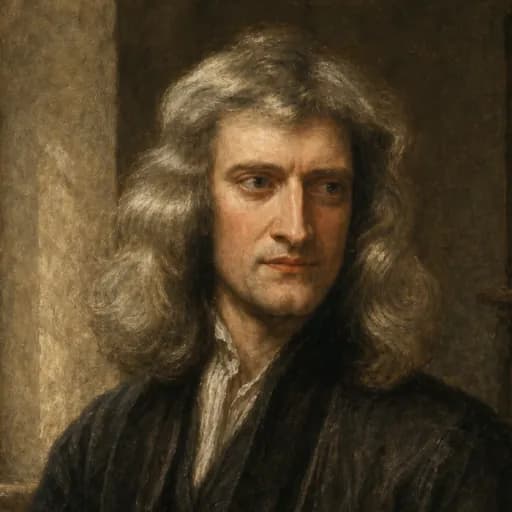
Translating geometric mechanics into analysis
Euler’s Mechanica gave the first extensive analytical formulation of Newtonian dynamics, turning Newton’s laws into the language of calculable differential equations.
Evidence for this connection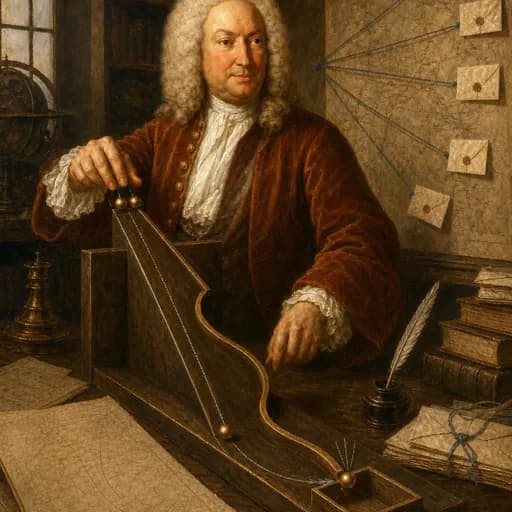
From Basel lessons to a master of analysis
Johann Bernoulli recognized the young Euler’s talent, tutored him privately, and helped persuade his family to let him pursue mathematics. This direct teaching became a central lineage of European analysis.
Evidence for this connection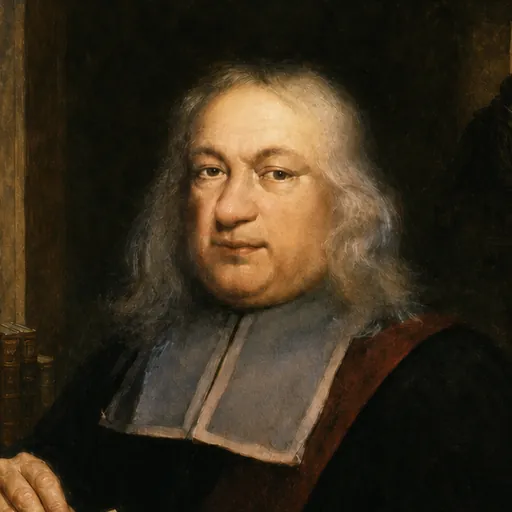
Turning unsupported claims into proofs
Euler systematically pursued Fermat’s number-theory challenges, extended Fermat’s little theorem, and treated the n=3 case of the Last Theorem.
Evidence for this connection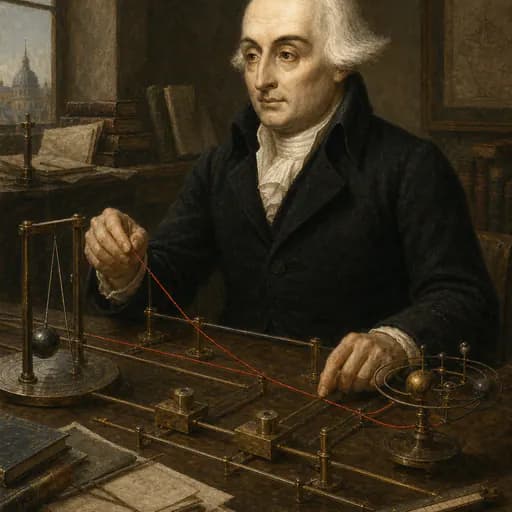
Passing on variation—and the Berlin chair
Euler immediately recognized and encouraged the young Lagrange’s work on the calculus of variations. Lagrange later succeeded him in Berlin and built analytical mechanics.
Evidence for this connection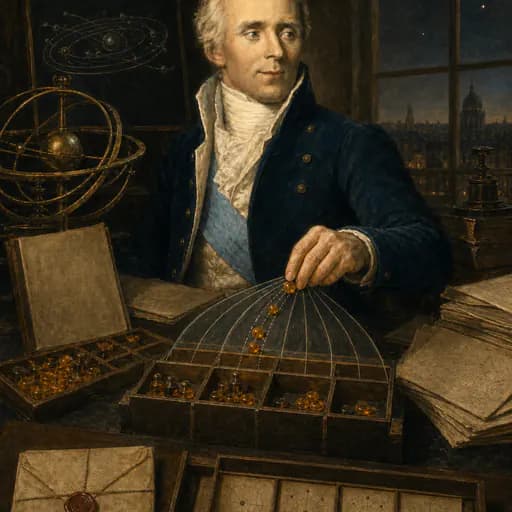
Celestial mechanics becomes a computational system
Laplace synthesized Euler’s analysis, differential equations, and celestial mechanics into a vast computational treatment of the solar system and probability.
Evidence for this connection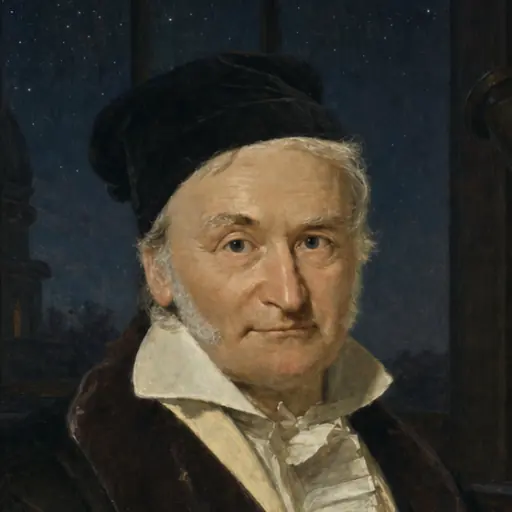
From computational number theory to structural number theory
Gauss reorganized the congruences, quadratic forms, and prime-number questions developed by Euler into the unified system of the Disquisitiones Arithmeticae.
Evidence for this connectionCurated sources and problems. Bring one discovery back from OEIS, Project Euler, MathOverflow, or arXiv.